Gravity Media, a world leading global provider of complex live creative production and media services, today detailed its collaboration with Roving Enterprises for another year to deliver the biggest night in Australian music, the ARIA Awards, taking place on 19 November.
This year’s production harnessed Gravity Media’s state-of-the-art UHD 11 outside broadcast truck, deploying 18 cameras to capture every moment from the red carpet, live ceremony, and fan zone.
Celebrating an incredible year for Australian music, the ARIA Awards unites the nation’s most impactful global artists with the next generation of rising talent.
The event streamed live on Wednesday 19 November on Paramount+ in Australia and worldwide with red carpet coverage airing from 7:00 PM AEDT on 10, featuring an ARIA stage debut for GRAMMY nominated singer-songwriter Olivia Dean and standout performances from Australian talent including Alex Lahey, Anna Ryan, Baker Boy, G Flip, Janet English, Keli Holiday, Kita Alexander, Missy Higgins, Neve Van Boxsel, Thelma Plum, Touch Sensitive, You Am I and Young Franco.
This year marks three consecutive years of collaboration between Gravity Media and Roving Enterprises on the ARIA Awards for a partnership that continues to set the benchmark for premium live event production in Australia.
Marcus Doherty, Account Executive – Media Services and Facilities at Gravity Media, commented:
“The ARIA Awards are one of the most iconic nights on Australia’s entertainment calendar and we’re proud to play a key role in bringing the live experience to audiences everywhere. It’s fantastic to once again collaborate with Roving Enterprises to deliver a world-class production.”
Following the ARIA Awards, Gravity Media in Australia will continue a busy end to the year, providing broadcast technology and production services for the NSW Schools Spectacular, Carols in the Domain, and early next year, the AACTA Awards.
Image courtesy of Liam Mahoney/ARIA
PRESS COVERAGE
There are very few global sporting events that can match the history and pedigree of The Championships, Wimbledon. The All England Lawn Tennis & Croquet Club’s (AELTC) annual event will be 150 years old in two years’ time, and our specialist camera division will be celebrating an unbroken quarter of a century of involvement with The Championships itself next year.
In 2001, we supplied the baseline track system and a single camera for Centre Court coverage. This year we supplied 44 remote camera systems on a typical day to Wimbledon Broadcast Services, which has been the host broadcaster since 2018, with Gravity Media specialist RF division provided exclusive RF cameras throughout the grounds. The cameras encompassed everything from compact rail systems to PTZ cameras, to robotic heads, to specialist units mounted on the Umpires Chair on the show courts, to a special gimbal-mounted unit on a hoist that you would more typically find on a helicopter. And they captured everything from close-up tennis action to press room coverage to beauty shots of the Wimbledon grounds from early in the morning to late – sometimes very late – at night.
In short it is the biggest annual project we get involved in as far as the amount and sheer variety of kit that we supply at an event. All in all, it takes around 100 crew days spread over an 18-day period to rig all the cameras. Only the Olympics is a bigger reoccurring project, and that only happens once every two years, not every year in SW19.
A HISTORY OF INNOVATION
WBS has an excellent track record of innovation when it comes to mounting the annual two-week coverage of The Championships. In 1967, Wimbledon provided the first ever colour broadcast in Britain, and recently WBS has helped pioneer remote production by providing simultaneous IP feeds to Rights Holders, been an enthusiastic early mover in ramping up fan engagement via expanded online coverage, created hugely successful dedicated apps, and more. Its use of specialist cameras is part of this overall heritage, and the organisation has come a long way since that initial railcam deployment on Centre Court 24 years ago.
One of the unique aspects of Wimbledon is that the built environment is very much a part of the whole event, and a lot of thought and effort has gone in over the years to make sure that any new cameras introduced are as unobtrusive as possible, as well as minimising seat kill. For example, the pill box style openings on the northern baselines on both Centre Court and Court One are custom-built hide structures that house rail cameras. These take three people a couple of days to build each.
Last year we introduced a new flown rail onto Centre Court to provide an additional moving angle high up in the back of the court. This was a complicated project to install and required close liaison with the AELTC but shows how the camera positions can evolve. It was originally envisaged as purely a beauty shot – Wimbledon is unusual in the number of beautycams we run throughout the fortnight, 16 this year – but we noticed directors cutting to the flown rail shots more and more in-between rallies and integrating them into the overall coverage of the actual matches. As a result, we upgraded the system for this year with improved lens stability.

There was also bespoke camera mounts on the Umpire’s Chairs on the two main courts (redesigned after the chairs were changed in 2023) plus the NetCam, developed in-house and mounted on the centre strap of the net capturing both players, plus numerous remotes positioned all around the site.
The majority of these remotes are our own self-developed SMARThead™ systems. As well as being dotted around the main courts, on the outside courts we rig five of them in Camera 1 positions two weeks before play starts. These need to be perfectly rigged, aligned, and weatherproofed from the start, as any adjustments made during The Championships require driving a cherry picker through the site to the camera and then being off-site again by 9am, and we avoid doing this as much as possible.
The robotic hoist cam is worth mentioning too. By using the sort of stabilised gimbal that you would usually find on a helicopter, we can use the full length of the lens and can zoom in tight onto anything of interest without any image shake. It can also stay aloft all day, even in adverse weather (the last dry event was in 2019, and there have only been eight tournaments without rain interruptions in the past 100 years), providing iconic images from across the grounds and of its 42,000 daily spectators.
This year there were 1500 hours of match footage captured alone, and many more hours from the beauty cameras and practice courts. WBS started providing a live behind-the-scenes feed to Rights Holders in 2023, and this necessitated us adding additional SMARThead™ positions; showing the arrivals journey from the new Somerset Road player’s entrance through a tunnel under the road into the club, and three more located in exclusive, usually hidden areas such as the Players Lawn and the entrance to The Championships dressing room – which is one of the few areas where our cameras do not venture.
CAPTURING THE CHAMPION’S WALK
In terms of RF, Wimbledon is a complex job. It’s a large site to be running wireless cameras on, but given the public access to most of it – over half a million spectators over the fortnight – and the unique ambience of the environment, RF cameras are an important alternative to yet more cable runs. Our specialist RF division installs up to 40 antennas across the site, allowing 16 broadcast cameras to roam all across the grounds. In recent years, such has been the demand we have maxed out the 2 GHz spectrum, and had to switch some units over to 7 GHz.
As well as the camera positions and the camera technology, over the years the RF has evolved too. More antennas have been added to ensure the Rights Holders can get the coverage they want from the areas they want, especially the practice courts. More data transmitters have also been added to ensure camera control works reliably everywhere.

One of the benefits of having a multi-year supply contract with a project of this nature is that you can invest properly to improve the coverage at key areas. This has come into focus in recent years thanks to the unique broadcasting challenge of the Walk of Champions. This consists of live Steadicam footage of the players exiting their dressing rooms and walking through the AELTC buildings to the Court itself before the Final, then the winner ascending to the balcony afterward. These paths follow a tortuous route through the buildings which was always an RF challenge for live broadcasting.
In recent years our long-term relationship with The Championships and WBS has enabled us to place antennas in the ceiling voids of the corridors and elsewhere along the route. These are disguised in the false ceiling so that they don’t detract from the look and feel of the Wimbledon environment and are a vital component in providing this one-of-a-kind footage to the live audience around the world.
And there are always a lot of people watching. Through 39 separate broadcast agreements, in 2025 The Championships was transmitted to over 220 territories around the world. Wimbledon says that because of the overlap of terrestrial, cable, satellite and internet streaming transmissions, it is impossible to calculate exact figures of the number of people who follow The Championships each year; but it is safe to say that it is seen by more people throughout the world than any other tennis tournament.
We’re delighted to be a part of that and, as the Championships have ended and the winners crowned, the Gravity Media specialist teams are already hard at work at plans for 2026 and beyond.
Watch this space…
?♀️On a weekend of winners we had the privilege of covering over 55,600 of them compete in this year’s record breaking London Marathon.
Covering every step and every emotion across the 26.2 mile course our crew were across London, once again delivering facilities for the world’s biggest Marathon.
With our trucks based at sites around the course, our RF beaming live moments across the city and our aerial coverage capturing London’s beauty from above – we helped ensure every moment was seen and felt.
A big thank you to our amazing crews and congratulations to every runner that took part!
Under blue skies and the iconic Wembley arch, our crew helped capture an historic Emirates FA Cup Final and Adobe Women’s FA Cup Final.
From our teams in Manchester and London producing the World Feed for all rights holding broadcasters, NOVA 314 was also on hand to deliver the big screen experience on site, and our specialist camera team were there to add to the match coverage and cover all the incredible goal action.
Our crew provided facilities for the live coverage of Trooping the Colour; from Buckingham Palace to Horse Guards Parade we helped capture every moment of this iconic event.
Our OB teams, alongside our specialist camera and RF teams delivered world-class broadcast facilities to ensure audiences around the world could experience the traditional pageantry involving 1350 troops and a flypast by the Red Arrows.
On Sunday 13th April, the 170th Boat Race was held on its traditional 4.25 mile course on the River Thames in London. Cambridge won both the men’s and women’s races in the 2025 Boat Race. With these victories, Cambridge University now has 88 wins in the men’s race and 49 in the women’s, bringing their total to 137 across both races. This highlights just how long the Boat Race has been going. Indeed, it will celebrate an astonishing 200 years in 2029, but at EMG / Gravity Media we’re currently just celebrating one: the first successful coverage of the race enabled by EMG Connectivity.
While our OBs have worked on the race for over ten years, 2025 is the first time that we have looked after the RF aspects of the event as well, making it a whole group effort. It represents some interesting challenges for RF too. Radio signals never propagate over water as well as they do over land, bridges block signals as the boats pass under them, while the end-to-end nature of the course and the fact that it winds through the built environment of London represents its own difficulties.
All in all its a huge operation with complex logistics that required almost 100 crew, 25 from EMG Connectivity alone, who had to start work days before the event to rig the antennas along the length of the course.
This year our team dealt with three separate councils for bay suspensions for parking and agreement for television work on council land; six private dwellings that were needed for camera or RF access; erected 46 scaffold points for camera positions and RF positions; utilised seven boathouses at the Putney end of the course; and then had to implement 24/7 security to make sure everything was still in place and where it should be with no surprises for the big day, 1500 hours of it in total.
CAPTURING ALL THE ACTION
As you would expect, there were both a lot of cameras dotted along the route and plenty both on the flotilla and covering its journey along the course to Mortlake. 25 were either in fixed positions or primarily assigned to specific areas on dry land.
“We had 16 antennas at the Putney Bridge OB receive site alone, with a network of receive antennas spanning the entire course,” explains Chris Brandrick, Commercial Director at EMG Connectivity. “In my 20 years working with wireless cameras, I’ve never encountered such a complex setup for a single RF project.”
As far as roving cameras go, EMG / Gravity Media’s specialist camera division, ACS, provided helicopter coverage using an advanced gyro-stabilised GSS Cineflex camera. Aerial views were further augmented via a DJI drone camera being operated from one of the chase boats. Additional ACS GSS Cineflex cameras were mounted on one of the chase boats and Umpire’s boat, ensuring perfectly stable close-up pictures of the racing action is it unfolded even in choppy waters.
As always, some of the most iconic images came from the University boats themselves. Each boat in the Men’s and Women’s races was equipped with two Dream Chip Atom One Mini Waterproof onboard cameras, housed in custom-built frames supplied by Videosys Broadcast. One camera was fixed, capturing the cox, while the other, a high-behind pan-and-tilt camera, provided a dynamic view of the rowers. A Domo Mesh unit enabled remote camera control and data control. To ensure clear footage, a compressed air system was also onboard to clear the lens if it got wet during the race.
Two different systems were used to coordinate and communicate between all those waterborne and aerial cameras.
The video transmission from all waterborne and airborne cameras was handled by the latest iteration of EMG Connectivity’s self-developed Livetools RF system which supports HEVC compression for even greater bandwidth efficiency. This proved itself on the Seine last summer during the Opening Ceremony of the Paris 2024 Olympics where our teams worked closely with NBC to deliver its coverage to the vast audiences watching in the US.
Similar to the Opening Ceremony in Paris, the reception of the RF signals from the boats uses shore-based receive sites along the river. Five sites were used with a total of 34 reception antennas. This is all brought back to the Putney Bridge main OB via an IP network, switched and decoded for a clean output on air from each camera.
“Livetools is proprietary to EMG / Gravity Media, and this marks its debut in the Boat Race. Introducing a new technology in such a high-profile event is always a bit nerve-wracking, especially when it’s the first time,” says Brandrick. “However, Livetools has already been proven in production, and we were confident it would perform on the Thames—and it did, as the stunning images from the Race demonstrated.”
A Domo Mesh network was used to communicate between the shore sites and all cameras, providing data and comms to each position through 20 deployed Mesh nodes along the route. Domo’s IP MESH creates a private, long-range, bidirectional IP network using a single frequency, where each node can serve as a data destination or a repeater to extend network coverage. This allows large-scale productions to maximise communication, delivering talkback, camera control, and transmitter function control.
GENERATING SUSTAINABILITY
With a number of camera single power positions along the course, as well as those on board the boats, a small petrol generator has traditionally been used to power the equipment. For this year’s race, however, after significant testing the team moved away from this method and opted to use eight Ecoflow Delta 3 units, which also have a solar charging input. The benefits to the environment are clear, but they also bring added benefits including less noise, no petrol onsite, no fumes, and fewer H&S considerations for storage etc. They are also much lighter!
A MARATHON ENDEAVOUR
There’s little time for the EMG Connectivity team to rest and relax though. Despite it being an odd year in the sporting calendar, the events are coming thick and fast and in under two weeks the TCS London Marathon takes place.
We’ve handled the RF and OBs for the event since 2014 and are continually evolving the way we implement its RF to not only reflect new technologies and production methods but also to cope with the many challenges it presents.
“The London Marathon is probably the most difficult marathon to cover in the world, because, like the Boat Race, it meanders through a heavily congested city,” says Brandrick, pointing to the forest of tall buildings that is Canary Wharf and the multiple tunnels along the course. “We do it differently to the Boat Race, however, with multiple fixed camera sites, two helicopters, and six motorbikes on the course that are relaying up to a single relay aircraft.”
There is a definite skill in implementing this. It’s a large area to cover with the bikes often extremely spread out on the course. The team needs to position the plane perfectly to ensure that coverage of the Elite runners and wheelchair racers finishing at Buckingham Palace is maintained while the mass start is still taking place at Blackheath 11 km away.
We’re also expanding on the innovation that so many enjoyed last year where McFly’s Harry Judd could contribute to the broadcast as he ran the course. This year the plan is to involve more celebrity runners, so we will be meeting them at badge collection and installing and testing a special app on their phones. Production can then call them during the race, ask them to fire up the app, and feature them talking as they’re running in the broadcast.
“The London Marathon and the Boat Race are both multi-site OBs, and they’re both sprawling events that wind through London, but in terms of RF they’re covered completely differently,” concludes Greg Livermore, EMG / Gravity Media’s Technical Producer for the Boat Race and the London Marathon. “They show the importance of tailoring RF differently to each and every event, to broadcaster’s requirements, to developments in technology, to the budget available, and to the unique characteristics of the sport and event in question.”
supertri was back in London’s docklands on 8th September for the fourth year running showcasing top triathlon talent in the short form, supertri events have expanded to five locations this year. The team visited two new sites in the US for the first two rounds before heading to London. Aurora Media Worldwide are the Host Broadcasters and have partnered with EMG / Gravity Media as facilities vendor. EMG / Gravity Media Unit Manager, Jon Giles, has been leading the technical planning and delivery for the second year running and explains the facilities delivery.
“August saw the start of the supertri season where we worked with our EMG / Gravity Media USA colleagues to deliver two successful events in Boston and Chicago. These run alongside local mass participation events which brings the added challenges of not being able to deploy many cameras (and cables) to final positions until an hour or so before on air as well as overcoming some of the challenges working around road closures, the public and different working cultures.
Our US team deployed Aspen, the newest truck in the US fleet for both events, supported by equipment from the US and UK and engineers from EMG / Gravity Media Connectivity for RF coverage. Our client, Aurora was really pleased with the facilities provided and while we had some location challenges I am proud to say we got everything online before transmission!!
supertri is distributed to numerous territories, and is usually available on Eurosport, YouTube, World Triathlon and many other domestic broadcasters. Next stop was the London event, with the broadcast available on BBC iPlayer, for what was a homecoming event for many of the successful Olympians from the Paris 2024 Olympic Games. The crowds were out in force to see Olympic Champions, Alex Yee and Cassandre Beaugrand alongside home favourites, including Georgia Taylor-Brown.
West India Quay, in the shadow of the Canary Wharf skyscrapers, is an exciting if tightly packed course for the athletes, taking in bumpy cobbles, pot-holed road surfaces, tight turns and hairpins. We deployed NOVA 118 to cover the event which took in five HDC-3500 line cameras, three handheld RF cameras, one RF polecam from EMG / Gravity Media specialist camera company, ACS, one RF Moto bike mounted camera, two minicams and two drone feeds – an eclectic mix of sensors and cameras on a sunny and challenging day for Vision!
Together with our Connectivity colleagues in our RF specialist division we worked with Motocam and Aerios Solutions to deliver the bike and drone cameras and delivered a faultless RF coverage of the bike and RF downlinking of the FPV drone. supertri and Aurora are keen to develop the use of drones in live TV events and for the second year we successfully worked together to catch a tiny 25mW signal from a racing drone with a fixed camera, hand off an ASI feed to the drone team who passed back the video signal for colour correction and use in the programme. Without any form of live camera control on board managing colour and exposure is challenging but with a combination of SV200s and V-pro processing we were able to achieve some impressive results.
The production team wanted the drone to fly at chest height behind the runners which, when surrounded by crowd in the finish straight, caused some RF issues but our ever-attentive RF team made adjustments to the antenna deployment to improve this further… live product development in action! Save to say this made the difference and the team were really pleased!
Coming up in October and November supertri moves onto Toulouse, France and NEOM, Kingdom of Saudi Arabia. Based on past experience these venues offer different challenges but with the help or our EMG / Gravity Media colleagues in France and the Middle East I’m confident we’ll deliver first class coverage for Aurora of these great venues!”
Background
EMG / Gravity Media were appointed by TNT Sports UK as the supplier of host broadcast services, unilateral services, as well as CCR, TOC and FANTV services on behalf of UEFA, at the 2024 UEFA Champions League Final (UCLF); the biggest domestic team event on the European football calendar held at the iconic Wembley Stadium in London on Saturday 1st June 2024.
With a global live match audience estimated at 145 million, watching Real Madrid’s win against Borussia Dortmund, the UCLF represented one of the company’s largest UK projects since the merger of EMG and Gravity Media with staff working together and demonstrating the combined technologies of the Group to support TNT Sports.
The Challenge
TNT Sports UK developed a world-class editorial strategy and technical plan to enable the delivery of its live coverage of the biggest game in club football. To support its production plans, TNT Sports UK contracted EMG / Gravity Media to supply supplementary equipment, RF facilities and crew not only for coverage of the match itself but also for MD-1 activities, team arrivals and the opening ceremony. In addition to this significant provision for the host broadcaster, the team supported a number of unilateral broadcast productions with their specific requirements. This included TNT Sports UK’s own channel presentation coverage, a comprehensive set-up for IMG to cover the match for CBS’ American audience, facilities for blue Sport Switzerland as well as UEFA’s bookable unilateral facilities, included in the multilateral production. In total, two-thirds of EMG / Gravity Media’s UK based fleet was brought in for this major event, for a deployment that included a total of 63 cameras, seven OB trucks plus helicopter coverage.
EMG / Gravity Media teams were also the supplier of the IP Technical Operation Centre (TOC), FAN TV and serviced up to 30 commentary positions on behalf of UEFA.
The Set-Up
TNT Sports UK’s host broadcast set-up comprised of a main OB truck taking in 42 camera feeds, including two super-slow RF HDR Steadicams; a second OB truck covered the ceremonies as well as acting as a back-up for the main truck; and a third OB truck provided service feeds for UEFA. These service feeds could be booked by broadcasters with specific unilateral requirements, such as flash or pitch-presentation stand-up interviews. 11 EVSs were housed in a cabin next to the main truck.
For TNT Sports UK’s own channel coverage, a further two trucks were available with 10 cameras to cover pitch-side presentations and natural coverage to supplement the host broadcast feed.
Two additional trucks were provided to IMG for CBS’ US coverage, 10 cameras plus a Steadicam 1080i50 SDR, an Autocue prompt system for the Steadicam and an RF monitor system working pitch-side.
Working with TNT Sports’ own team, EMG Connectivity coordinated RF frequencies including all the cameras, monitors and camera control. In addition to the stadium requirements, links were co-ordinated for a static beauty camera located on a rooftop on Wembley Way looking back at the stadium, as well as a downlink and production talk back to and from a helicopter that captured aerial shots of the team coach arrivals and the stadium itself. EMG / Gravity Media’s specialist camera division, ACS, supplied the helicopter and aerial coordination with a GSS stabilised gimbal package in HD 1080p HDR format.
Within the stadium, specialist cameras included two SMARTgrip™ systems positioned behind the goals, a SMARThead™ remote head with Sony HDC-P50 camera offering tunnel coverage and a new addition to the Final’s coverage with two HFR ‘Manager-Cam’ systems.
A crew of over 180 combined TNT Sports and EMG / Gravity Media visual, audio and technical engineers rigged, tested, operated and maintained the equipment for the entire event.
The Result
EMG Head of Production Operations, Chrissie Collins, commented:
“This match is always one of the most anticipated sporting events of the year, the conclusion of the exciting European season and an absolute highlight for anyone who loves football. For our clients, the stakes are high and it’s imperative that the broadcast goes without a hitch. For EMG / Gravity Media, it was one of the largest UK events handled this year and there were a lot of moving parts to coordinate. We’re so proud of our talented crew from across our expanded company, who came together and worked incredibly hard to produce such a fantastic result.”
Aerial Camera Systems (ACS) and EMG Connectivity extend existing contracts and prepare for their biggest ever broadcast of The Championships at Wimbledon.
EMG Group companies Aerial Camera Systems (ACS) and EMG Connectivity (previously Broadcast RF) are delighted to announce a four-year extension of their contract with Wimbledon Broadcast Services (WBS) to be the specialist cameras and RF equipment supplier to The Championships, Wimbledon, staged by the All England Club’s annual Championships.
The two-week tennis event is one of the largest annual sports Outside Broadcasts undertaken in the UK and a huge project for all the companies involved. EMG Connectivity has supplied various broadcasters’ RF Services & Connectivity over several years but became the exclusive supplier of RF cameras when WBS took over the host broadcasting of The Championships from the BBC in 2018, while ACS has been involved on site for over 20 years.
“When we first started working with the BBC at Wimbledon we only supplied three or four camera systems. That provision has steadily grown and when WBS took over as host broadcaster they placed additional emphasis on creating unique shots of The Championships by placing more remotes around the Grounds to capture, for example, the crowd atmosphere and the players’ practice areas. This year will be our largest Championships delivery to date, with the supply of 46 SMARThead™ robotic camera channels and 26 operators supported by a small team of technicians and three on-site vision engineers,” comments Matt Coyde, Sales Director at ACS.
Broadcast standard compact robotic cameras are often preferred at the All England Club’s historic venue in SW19 as their unobtrusive nature minimises space requirements and line of sight issues making their use ideal within the confines of the Grounds. This year, the vast majority of camera systems are either UHD or 1080p HDR for the first time as WBS expands the high-quality format support from Centre Court out to all cameras at The Championships.
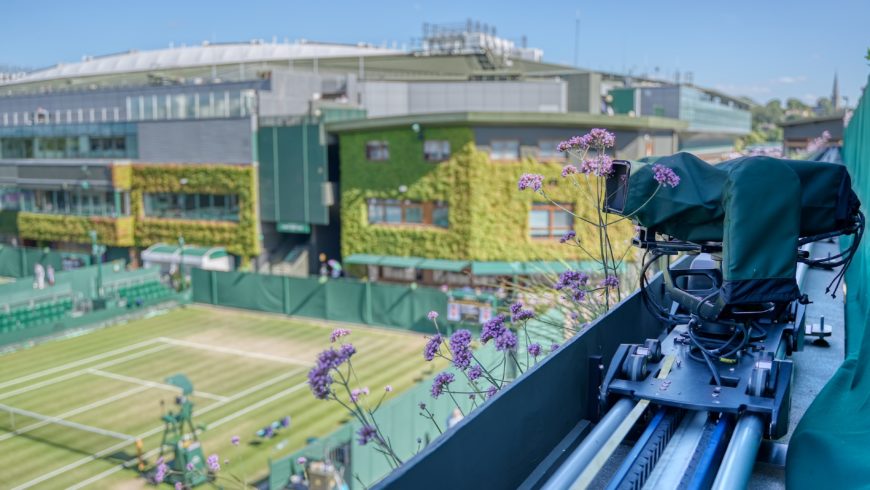
Centre Court itself features some notable specialist units including an ACS SMARThead™ mounted on a 10m railcam positioned along the baseline and housed within a purpose-built hide, whilst another four units are mounted on bespoke camera brackets designed specifically for Wimbledon, including two on the umpire’s chair dedicated to player coverage. In addition to the two tracks in Centre Court and No.1 Court, ACS is also supplying rail systems covering the Southern and Northern courts at the Club. As well as covering several angles of on-court play, numerous beauty cameras provide contextual coverage of the event and include remote crowd cams, coverage of the player arrivals area, Aorangi practice courts, and Media Theatre, plus topographic venue shots from a hoist-mounted GSS stabilised camera gimbal sitting high above the venue for the iconic overhead shots of the local area and London skyline.
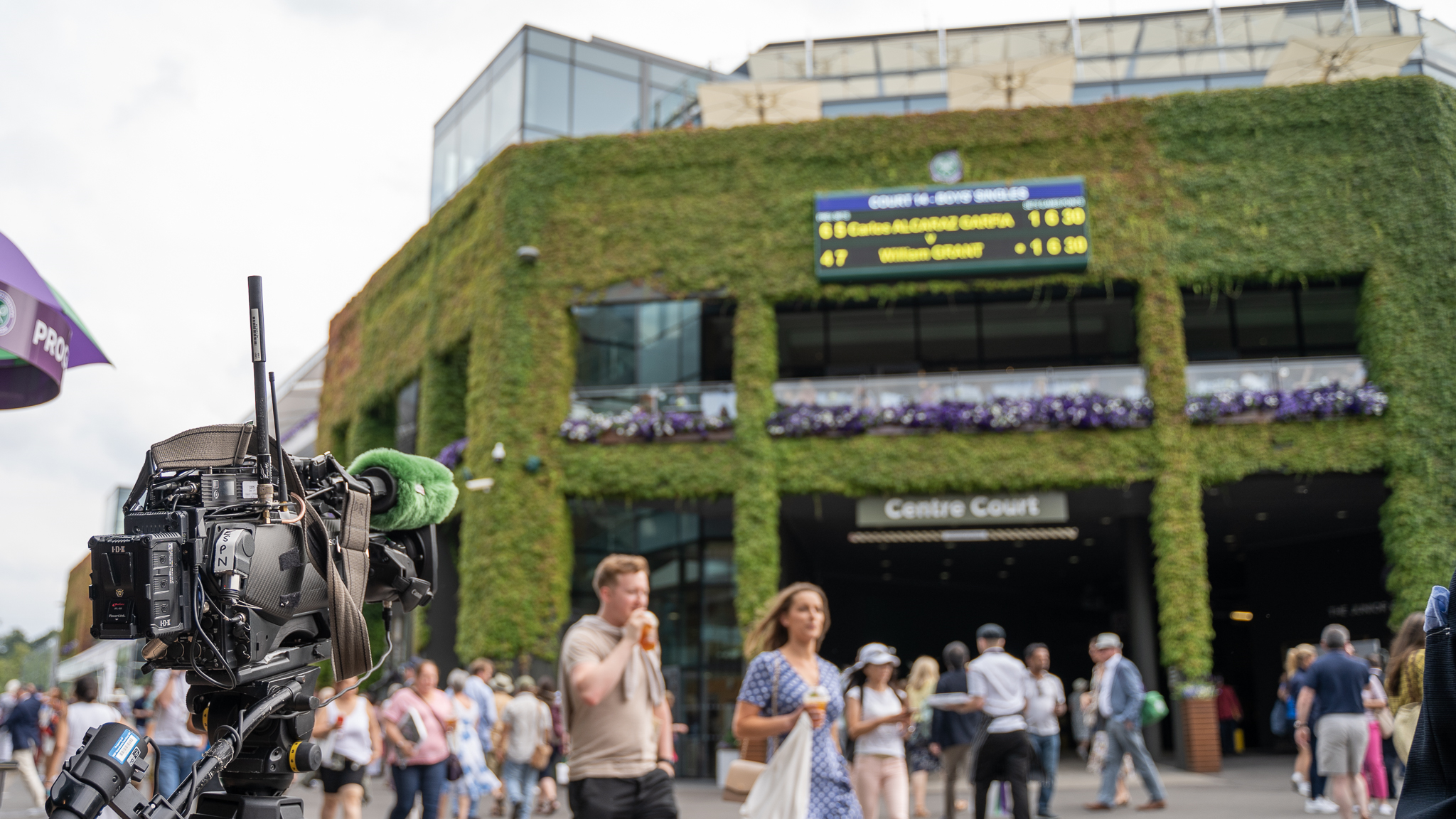
EMG Connectivity meanwhile is providing a wide range of kit and expertise to both the host and multiple unilateral broadcasters, supported by a crew of 6 for fortnight and more for the rig and de-rig of The Championships. There are 40 antennas site wide which feedback to a central RF cabin in the Broadcast Compound, switched and fed into their appropriate receiver units. This is a cost effective way of multiple area coverage for events such as Wimbledon and golf events such as the Open and the Ryder Cup. A wide area return video system for roving RF monitors is also provided to a number of broadcasters, allowing them to analyse footage from anywhere within the Grounds.
Walk of Champions:
One of the challenges for the EMG Connectivity team is to ensure smooth steadicam RF coverage of the Walk of Champions from the Dressing Rooms to the entrance of Centre Court pre-match. They also cover the champion from Centre Court up the stairs of the Clubhouse, through the corridor to the Dressing Rooms and onto the Members’ balcony to be greeted by the cheering crowd. This requires its own dedicated receive installation with antennas secreted within the walkways and corridors, providing seamless coverage within the building and in addition to the 40 antennas EMG Connectivity have around the Grounds.
“This is the first year that some of the RHBs have returned with onsite presentation to Wimbledon,” says Chris Brandrick, Commercial Director at EMG Connectivity. “It means we will be supplying more RF cameras and RF monitors than ever before. With our seamless wireless connectivity which unites the fans and the players, we are confident we can set the bar higher than ever before.”
“We are delighted to extend our relationship with ACS and EMG Connectivity as we continue to evolve our coverage to provide new standards of quality and innovation in the broadcast of Wimbledon” comments Paul Davies, Head of Broadcast, Production and Media Rights at the All England Club.
The Championships begin on Monday 3 July.
