*English version below
De slimste weg van data naar graphics
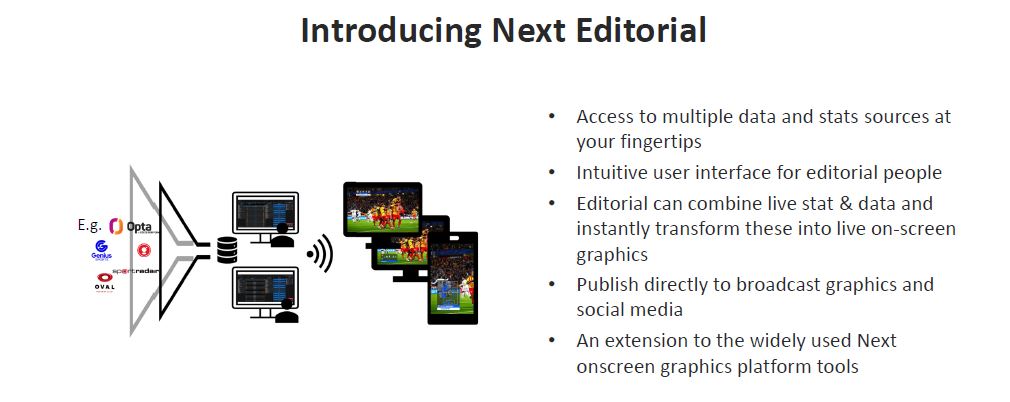
In onze voetbalverslaggeving gaan we de Amerikanen achterna: steeds vaker krijgen we cijfers en statistieken te zien over zaken als balbezit, balveroveringen, passnauwkeurigheid of schoten op doel. Om de workflow van data naar graphics te ondersteunen, hebben ze bij Boost Graphics een nieuw platform: Next Editorial. ‘We laten AI zelfs al meedenken, dat levert mooie suggesties op.’
De kleur van de veters zal nog net niet worden vastgelegd, maar verder ontsnapt weinig aan de dataverzameling rond sportwedstrijden. Van elke speler kunnen eindeloze statistieken worden overlegd, van speelminuten tot voltooide passes, afgelegde afstand en heatmaps voor balcontacten. En dan hebben we het alleen nog over voetbal, maar vrijwel elke sportbond heeft contracten met zogenaamde ‘statproviders’, die alle mogelijke gegevens over wedstrijden, teams en spelers vastleggen en gegroepeerd kunnen uitserveren. Dat gebeurt alleen niet altijd even overzichtelijk, vertelt Jeroen van Rossum, director of operations bij Boost International. “De data die we in graphics op het scherm willen tonen, worden aangeleverd in verschillende formats. In de huidige werkwijze werkt de redacteur samen met de graphics operator om te bepalen welke data interessant zijn. Dan maakt de operator van die data een graphic en zet deze vervolgens live. Met Next Editorial heeft de redacteur niet alleen een tool beschikbaar die inzicht geeft in de beschikbare live data, hij kan die vervolgens ook zelf in een graphic template zetten als preview, die hij kiesbaar kan maken voor de operator. De benodigde graphics zijn er dus een stuk sneller, dat scheelt nogal tijdens een live-uitzending met de nodige tijdsdruk. Daarnaast hebben we een AI-functionaliteit toegevoegd die inhoudelijk suggesties kan doen op basis van de beschikbare live data.”
Betere storytelling
Die nieuwe functionaliteit kijkt mee in de data die wordt verstrekt door de statistiekleverancier. Omdat deze AI-tool de data leest en de context kent, kan de redacteur ’m gebruiken als een soort Copilot. Van Rossum: “Kijk, zegt het systeem, deze cijfers kunnen voor jou relevant zijn. Het is een recommendation engine. Het voordeel voor de redacteur is dat die in meerdere live databronnen kan zoeken om combinaties te maken tussen twee teams, om maar wat te noemen, of om juist heel specifieke info van één speler weer te geven. Hij heeft dat allemaal in een overzichtelijke interface beschikbaar, waarmee hij de graphic meteen kan voorbereiden. Dan ziet hij ook hoe het eruit komt te zien op het scherm.” Het voordeel gaat verder dan enkel tijdwinst. Doordat de redacteur de gesuggereerde of zelf voorbereide graphics snel in een vorm kan gieten, kan de operator zich volledig focussen op de wedstrijd. Van Rossum: “Als er extra info te geven is, dan komt de redacteur daar mee. Zo maak je samen het inhoudelijke verhaal, je hebt daar meer tijd voor. En zo krijg je betere storytelling. Next Editorial is een tool die de inhoudelijke mensen rondom een sportwedstrijd niet alleen ondersteunt en meer inzicht geeft, maar ook de snelheid van het live zetten van data in de vorm van graphics enorm verhoogt.”
AI als ondersteuning
Next Editorial is halverwege het vorige voetbalseizoen voor het eerst ingezet in Frankrijk en wordt sinds dit seizoen standaard bij iedere competitiewedstrijd in Ligue 1 gebruikt. De eerste ervaringen met het systeem zijn erg positief, ook de AI-tool werd in de eerste testfase goed ontvangen. De functie is beschikbaar binnen het platform, maar zal in de verschillende landen gefaseerd worden geïntroduceerd. “De redacteuren moeten ermee leren werken. Ze gaan hopelijk ervaren dat het fijn werkt als je slimme suggesties krijgt. Dat mag iedereen in zijn eigen tempo doen, maar ik verwacht dat ze dit snel zullen omarmen. We zetten AI in als ondersteuning, daar zit de meerwaarde ervan.”
ENGLISH VERSION BELOW
Boost Graphics’ new platform: Next Editorial
The smartest route from data to graphics
In football coverage, we are following the American lead; we are seeing more and more numbers and statistics on things like possession, ball recoveries, pass accuracy and shots on target. To support the workflow from data to graphics, Boost Graphics has launched a new platform, Next Editorial. The platform even lets AI think along, yielding smart suggestions.
They may not log lace colour just yet, but very little escapes data collection around sports matches. For every player there are endless statistics, from minutes played to completed passes, distance covered and heat maps for touches. And that is only football. Virtually every sports federation has contracts with stat providers, who record data about matches, teams and players and deliver it in grouped formats. That does not always arrive in an equally clear way, says Jeroen van Rossum, director of operations at Boost International. “The data we want to show as on-screen graphics is supplied in different formats. In the current workflow the editor works with the graphics operator to decide which data is interesting. The operator then turns that data into a graphic and puts it live. With Next Editorial the editor not only has a tool that gives insight into the available live data, but they can also place that data directly into a graphic template as a preview, which they can make selectable for the operator. The required graphics are produced much faster, which makes a big difference during a live broadcast with time pressure. On top of that we have added an AI feature that can make content suggestions based on the available live data.”
Better storytelling
The new feature analyses data from the stats providers. Because this AI tool reads the data and knows the context, the editor can use it like a copilot. Van Rossum adds, “In effect, the system highlights which numbers may be relevant — it acts as a recommendation engine. The advantage for the editor is that they can search across multiple live data sources to make combinations between two teams, for example, or to display very specific information about a single player. All of this is available within a clear interface, where the editor also sees how it will look on screen and can prepare the graphic immediately.”
The benefit goes beyond saving time. Because the editor can quickly shape the suggested or self-prepared graphics, the operator can focus fully on the match. “If there is extra information to add, the editor brings it in,” says Van Rossum. “That way you build the story together and have more time to focus on the content, which ultimately leads to better storytelling. Next Editorial not only supports the editorial team during a live sports match and gives them greater insight, it also greatly increases the speed at which live data can be taken on air as graphics.”
AI as support
Next Editorial was first deployed halfway through last football season in France and has been used by default for every league match in Ligue 1 since this season. The first experiences with the system were very positive, and the AI tool was also well received in the initial test phase. The feature is available within the platform and will be rolled out in phases across different countries. Van Rossum concludes, “Editors need to learn how to work with it, and everyone can adopt it at their own pace, but I expect they will embrace it quickly. We use AI as support; that is where its value lies.”
Gravity Media, a world leading global provider of complex live creative production and media services, today detailed Gravity Media’s collaboration with the New South Wales Department of Education’s Arts Unit in a broadcast technology and television production undertaking to create and deliver this year’s Schools Spectacular – REMARKABLE!, one of the biggest live events in Australia, and the event’s national broadcast on the Seven Network, Friday December 19 from 7pm AEDT.
The New South Wales School Spectacular is the world’s largest annual amateur variety show and is produced by the New South Wales Department of Education’s Arts Unit. This year’s event REMARKABLE! celebrates the 42nd annual staging of the event.
Gravity Media has been the driving force behind the NSW Schools Spectacular national television broadcast since 2016, and in collaboration with the NSW Department of Education’s Arts Unit, Gravity Media proudly serves as the Event Partner for the 2025 event: Schools Spectacular – REMARKABLE!
In a significant broadcast undertaking for the 2025 event, Gravity Media will be accessing advanced formats for a captivating television production with higher resolution, more accurate colours, and smoother motion than ever before.
Schools Spectacular – REMARKABLE! encompasses four live arena shows at Qudos Bank Arena in Sydney Olympic Park with a national broadcast across Australia on the Seven Network.

Each of the four live arena performances over two days features over 5,500 students from NSW public schools including 2,300 dancers, a combined choir of 2,500, an 80-piece symphony orchestra, a stage band, the D’Arts Ensemble for students with disability, the Aboriginal Dance Ensemble, boy’s hip-hop ensemble, and circus arts ensemble.
From producing dazzling performer and teacher backstory content, crafting the event and broadcast promos, providing comprehensive graphic design services, to a cine film unit travelling 3,000 kilometres throughout regional and rural New South Wales capturing the talents of the state’s public-school students for the show’s opener, Gravity Media is delivering a comprehensive turnkey production outcome for the event.
The Gravity Media undertaking involves a total television production and technical staff of 75, deploying a state-of-the-art high definition outside broadcast truck and accessing 15 broadcast and specialist cameras, including Steadicams, Jib Cranes, Dolly Shot, and Spidercam, to deliver the complete television production for the New South Wales Department of Education and the Seven Network.
Richard Spiewak, Executive Producer at NSW Department of Education – Arts Unit said:
“This year’s show is titled “Remarkable” and is a fitting tribute to the extraordinary achievements of students across NSW public schools. Now in its 42nd year, the Schools Spectacular continues to be a vibrant celebration of the arts, showcasing the incredible talent, dedication, and creativity nurtured in our public education system.”
“The broadcast is an important component to the live production and allows us to reach right across Australia to highlight our remarkable students.”
Mike Purcell, Head of Production at Gravity Media in Australia, said:
“NSW Schools Spectacular showcases the incredible depth of talent in NSW public schools, and we’re proud to bear that to screen.”
“It’s been a pleasure to partner and collaborate with The Arts Unit for almost a decade allowing us to innovate and provide fresh creative ideas each year, something our entire team is proud of.”
“A truly ‘REMARKABLE!’ world-class event and broadcast.”
PRESS COVERAGE
*English version below
De slimste weg van data naar graphics
In onze voetbalverslaggeving gaan we de Amerikanen achterna: steeds vaker krijgen we cijfers en statistieken te zien over zaken als balbezit, balveroveringen, passnauwkeurigheid of schoten op doel. Om de workflow van data naar graphics te ondersteunen, hebben ze bij Boost Graphics een nieuw platform: Next Editorial. ‘We laten AI zelfs al meedenken, dat levert mooie suggesties op.’
De kleur van de veters zal nog net niet worden vastgelegd, maar verder ontsnapt weinig aan de dataverzameling rond sportwedstrijden. Van elke speler kunnen eindeloze statistieken worden overlegd, van speelminuten tot voltooide passes, afgelegde afstand en heatmaps voor balcontacten. En dan hebben we het alleen nog over voetbal, maar vrijwel elke sportbond heeft contracten met zogenaamde ‘statproviders’, die alle mogelijke gegevens over wedstrijden, teams en spelers vastleggen en gegroepeerd kunnen uitserveren. Dat gebeurt alleen niet altijd even overzichtelijk, vertelt Jeroen van Rossum, director of operations bij Boost International. “De data die we in graphics op het scherm willen tonen, worden aangeleverd in verschillende formats. In de huidige werkwijze werkt de redacteur samen met de graphics operator om te bepalen welke data interessant zijn. Dan maakt de operator van die data een graphic en zet deze vervolgens live. Met Next Editorial heeft de redacteur niet alleen een tool beschikbaar die inzicht geeft in de beschikbare live data, hij kan die vervolgens ook zelf in een graphic template zetten als preview, die hij kiesbaar kan maken voor de operator. De benodigde graphics zijn er dus een stuk sneller, dat scheelt nogal tijdens een live-uitzending met de nodige tijdsdruk. Daarnaast hebben we een AI-functionaliteit toegevoegd die inhoudelijk suggesties kan doen op basis van de beschikbare live data.”
Betere storytelling
Die nieuwe functionaliteit kijkt mee in de data die wordt verstrekt door de statistiekleverancier. Omdat deze AI-tool de data leest en de context kent, kan de redacteur ’m gebruiken als een soort Copilot. Van Rossum: “Kijk, zegt het systeem, deze cijfers kunnen voor jou relevant zijn. Het is een recommendation engine. Het voordeel voor de redacteur is dat die in meerdere live databronnen kan zoeken om combinaties te maken tussen twee teams, om maar wat te noemen, of om juist heel specifieke info van één speler weer te geven. Hij heeft dat allemaal in een overzichtelijke interface beschikbaar, waarmee hij de graphic meteen kan voorbereiden. Dan ziet hij ook hoe het eruit komt te zien op het scherm.” Het voordeel gaat verder dan enkel tijdwinst. Doordat de redacteur de gesuggereerde of zelf voorbereide graphics snel in een vorm kan gieten, kan de operator zich volledig focussen op de wedstrijd. Van Rossum: “Als er extra info te geven is, dan komt de redacteur daar mee. Zo maak je samen het inhoudelijke verhaal, je hebt daar meer tijd voor. En zo krijg je betere storytelling. Next Editorial is een tool die de inhoudelijke mensen rondom een sportwedstrijd niet alleen ondersteunt en meer inzicht geeft, maar ook de snelheid van het live zetten van data in de vorm van graphics enorm verhoogt.”

AI als ondersteuning
Next Editorial is halverwege het vorige voetbalseizoen voor het eerst ingezet in Frankrijk en wordt sinds dit seizoen standaard bij iedere competitiewedstrijd in Ligue 1 gebruikt. De eerste ervaringen met het systeem zijn erg positief, ook de AI-tool werd in de eerste testfase goed ontvangen. De functie is beschikbaar binnen het platform, maar zal in de verschillende landen gefaseerd worden geïntroduceerd. “De redacteuren moeten ermee leren werken. Ze gaan hopelijk ervaren dat het fijn werkt als je slimme suggesties krijgt. Dat mag iedereen in zijn eigen tempo doen, maar ik verwacht dat ze dit snel zullen omarmen. We zetten AI in als ondersteuning, daar zit de meerwaarde ervan.”
ENGLISH VERSION BELOW
Boost Graphics’ new platform: Next Editorial
The smartest route from data to graphics
In football coverage, we are following the American lead; we are seeing more and more numbers and statistics on things like possession, ball recoveries, pass accuracy and shots on target. To support the workflow from data to graphics, Boost Graphics has launched a new platform, Next Editorial. The platform even lets AI think along, yielding smart suggestions.
They may not log lace colour just yet, but very little escapes data collection around sports matches. For every player there are endless statistics, from minutes played to completed passes, distance covered and heat maps for touches. And that is only football. Virtually every sports federation has contracts with stat providers, who record data about matches, teams and players and deliver it in grouped formats. That does not always arrive in an equally clear way, says Jeroen van Rossum, director of operations at Boost International. “The data we want to show as on-screen graphics is supplied in different formats. In the current workflow the editor works with the graphics operator to decide which data is interesting. The operator then turns that data into a graphic and puts it live. With Next Editorial the editor not only has a tool that gives insight into the available live data, but they can also place that data directly into a graphic template as a preview, which they can make selectable for the operator. The required graphics are produced much faster, which makes a big difference during a live broadcast with time pressure. On top of that we have added an AI feature that can make content suggestions based on the available live data.”
Better storytelling
The new feature analyses data from the stats providers. Because this AI tool reads the data and knows the context, the editor can use it like a copilot. Van Rossum adds, “In effect, the system highlights which numbers may be relevant — it acts as a recommendation engine. The advantage for the editor is that they can search across multiple live data sources to make combinations between two teams, for example, or to display very specific information about a single player. All of this is available within a clear interface, where the editor also sees how it will look on screen and can prepare the graphic immediately.”
The benefit goes beyond saving time. Because the editor can quickly shape the suggested or self-prepared graphics, the operator can focus fully on the match. “If there is extra information to add, the editor brings it in,” says Van Rossum. “That way you build the story together and have more time to focus on the content, which ultimately leads to better storytelling. Next Editorial not only supports the editorial team during a live sports match and gives them greater insight, it also greatly increases the speed at which live data can be taken on air as graphics.”
AI as support
Next Editorial was first deployed halfway through last football season in France and has been used by default for every league match in Ligue 1 since this season. The first experiences with the system were very positive, and the AI tool was also well received in the initial test phase. The feature is available within the platform and will be rolled out in phases across different countries. Van Rossum concludes, “Editors need to learn how to work with it, and everyone can adopt it at their own pace, but I expect they will embrace it quickly. We use AI as support; that is where its value lies.”
Gravity Media, the leading force in production and content, media services and facilities, today detailed the combining of forces of Gravity Media’s teams in Australia and Belgium to deliver the broadcast technology and television production undertaking that saw Gravity Media create and deliver the broadcast and packaged content for the Pho3nix Sport with Purpose in Switzerland.
The complex undertaking underlines Gravity Media’s global creative production and technology capabilities in combining forces across multiple territories to deliver every on-screen element for the event.
A team from Gravity Media in Australia crossed the globe capturing the essence of Sport with Purpose, the stories of Olympians and young athletes in eleven countries whose lives are shaped by Pho3nix initiatives.
From the rainforests of Rwanda, the Swiss Alps, the streets of Bangkok, the hustle and bustle of Lagos in Nigeria, and multiple locations in South Africa, Ghana, Austria, Switzerland, Poland, UK, Australia, and the Philippines, Gravity Media’s Australian team of five has completed a significant logistical and production undertaking utilising ten road cases of broadcast and filming equipment, including 4K cine-cameras, specialised super-slo, and mini-cameras and all sound, lighting and rigging production requirements.
Following six weeks of filming and production, Gravity Media’s post-production team in Sydney has created 11 mini-documentaries for the inaugural Pho3nix Sport with Purpose Charity Gala held in the iconic Dolder Grand in Zurich, Switzerland on 19 September.
Gravity Media’s in-house creative team in Sydney was also engaged in the production of all screen content and graphic design for the inaugural Pho3nix Sport With Purpose Charity Gala.
Gravity Media’s team in Belgium was then appointed to deliver the broadcast technology and production undertaking for the global broadcast of the Gala across the Pho3nix Foundation’s social channels, accessing one of Gravity Media’s state-of-the-art high definition outside broadcast trucks, an array of jibs, cine Steadicams, Glambot and drone camera technologies and a crew of 25.
The Pho3nix Sport with Purpose Charity Gala featured host James Corden and Laura Woods with headline guests such as Usain Bolt, Anthony Joshua and Chris Froome, marking a celebration of creating meaningful impact through the power of sport through grants, educational programmes, and awards to shape a positive future for children.
The gala shared personal stories from Olympians and emerging athletes whose lives have been shaped by Pho3nix initiatives, such as the Pho3nix Kids Football in Rwanda, Move 4 Life parkour in Thailand, and Kids Fun Runs in Ghana, which demonstrate how sport can create new pathways for children and communities across the globe.
The Pho3nix Foundation is a global non-profit founded and chaired by philanthropist Sebastian Kulczyk.
At the helm of this landmark event is Mana Group, the Pho3nix Foundation’s strategic delivery partner.
Gravity Media was appointed by Mana Group to deliver the creative production outcome for the Pho3nix Foundation
Mike Purcell, Head of Production at Gravity Media Australia commented:
”It is a pleasure for Gravity Media to partner with Mana Group to tell and highlight the wonderful story of the Pho3nix Foundation’s work. To see first-hand the social impact the Pho3nix Foundation brings to kids, local organisations, communities, and athletes globally, brings to light the importance to keep kids active and support up and coming athletes. It is Sport With Purpose.”
Nathalie De Mey, Project Coordinator at Gravity Media Belgium commented:
“For Gravity Media in Belgium, it was great to be collaborating with our team in Australia for the first time. We are delighted to be involved in this valuable project, not only because of the impact of the Pho3nix Foundation, but also because it transcends boundaries within Gravity Media. We are proud to be one global powerhouse brand and contribute to such an important social initiative.”
Trent Taylor, CEO of Mana Group commented:
“The Pho3nix Sport with Purpose Gala is a landmark moment that showcases the life-changing power of sport, and we are proud to have appointed Gravity Media to help bring these stories to life on a global stage. Their ability to combine world-class creative production with broadcast technology across multiple continents ensures that the impact of Pho3nix initiatives, from Rwanda to Bangkok to Zurich, will be shared with audiences everywhere. Mana Group’s partnership with Gravity Media builds on years of collaboration across some of the world’s most ambitious sporting projects, and together we are delivering a production worthy of the athletes, children, and communities whose stories will inspire the world.”
The appointment of Gravity Media to create and deliver the production outcome for the Pho3nix Foundation builds on Gravity Media’s long-term partnership with Mana Group which sees Gravity Media working with Mana Group across an array of events including Sub7 and Sub 8 broadcasts and documentaries, Super League Triathlon, Ironman, Stawell Gift and Greatest Mental Health Awareness for New South Wales Department of Education.
PRESS COVERAGE
The 82nd Goodwood Member’s Meeting was a weekend of speed, style, and history set against the unique backdrop of the South Downs and our comprehensive, end-to-end production was on site to cover it all as we celebrated our fourth year as a production partner for Goodwood!
Alongside our OB truck NOVA 112, our team brought the action to life with over 30 cameras including drone aerials and onboard specialist cameras to capture every moment of this iconic event.
Boost Graphics, our specialist international graphics and virtual production subsidiary delivered the live graphics fully integrated with race timing and data.
The full production set up saw our team deliver over 20 hours of live TV coverage for the world feed, which was broadcast globally alongside a highlights show for ITV in the UK.
Interview with Alessandro Curti, Head of Graphics at EMG Italy
EMG Italy and RCS Sport have renewed their partnership for the production of the leading Italian cycling events, with a strong focus on technological innovation, editorial quality and integrated management. Giro d’Italia 2025 will feature advanced systems including live data-driven graphics, drones, artificial intelligence and pixel tracking.
More than 120 professionals are involved, along with a mobile production unit for the international feed and tailored streams for digital platforms. The aim is to deliver an increasingly immersive and technically refined television experience.
“Last year we implemented a number of new graphic solutions, and this year we’ve continued along the same path,” says Alessandro Curti, Head of Boost Graphics in Italy, the international broadcast graphics division of EMG / Gravity Media.
“This year’s project involved advanced technologies, new data collection systems, and a significant expansion of the features dedicated to the live television production of cycling’s flagship event, the Giro d’Italia.”

RCS Sport has entrusted EMG / Gravity Media Italy with the international production and distribution of its cycling events, while all graphics operations are managed by its subsidiary Boost Graphics.
This collaboration allows for early-season trials of new tools during events like the UAE Tour, Strade Bianche, Tirreno-Adriatico and Milano-Sanremo, which are then fully developed and deployed at the Giro. Other RCS races follow: Milano-Torino, Gran Piemonte and Il Lombardia. Since last year, new additions include Sanremo Women, Giro Donne and Giro Next Gen, expanding the calendar of covered events.
The Giro represents the culmination of all graphic innovations tested throughout the season.
Among the key developments this year are new solutions that highlight athlete data: in addition to biometric parameters (speed, cadence, power output in watts) previously limited to a few riders, the 2025 edition features a greatly expanded dataset.
Additional information such as weather conditions, cultural content and historical notes on each stage location have also been integrated, some of which are provided directly by the organiser through dedicated tools developed to enhance their graphic representation.

“For biometric data collection,” Curti explains, “we’ve developed a new system in collaboration with VELON, an external partner of RCS. The data are captured by sensors mounted on the bikes, transmitted via mobile networks using transponders, and sent to a central data hub. From there, the information is transferred via API and internet connection to the Boost Graphics operations centre, where it is processed in real time and provided to the main production director.”
Boost Graphics has also developed a custom application for collecting and managing this statistical data.
Almost every bike (within technical limits) is equipped with a transponder, and the transmitted data is processed to create athlete-specific biometric graphics, enabling dynamic comparisons between riders in breakaways, in the peloton or among general classification contenders.
All of this is integrated into the live graphic flow for the international feed. The transponder signals are first received by the VELON hub and then sent via mobile network (which can present challenges in mountainous terrain) to Boost’s graphics hub, where the system processes the data with minimal latency. Graphic operators select the most relevant content in line with the narrative choices of the live director. The data feed is continuous, but only pertinent elements are broadcast, using templates created during the off-season.

Live images are accompanied by informative graphics, from weather and biometric data to group composition and breakaway formations. A single graphics coordinator maintains direct contact with the director to ensure editorial consistency. Three Boost Graphics OB vans are stationed at each stage finish, staffed by personnel managing timing (in partnership with Microplus), intermediate sprints, stage results, secretariat tasks and photo finish.
“One of the key innovations in 2025,” adds Curti, “is the introduction of the ‘Red Bull kilometre’, a new intermediate sprint that required the development of dedicated and branded graphics. We’ve also expanded our technical infrastructure: six OB graphic vehicles in total—three at the finish and three along the course to manage the intermediate sprints. Two additional graphic workstations have been installed on one of the OB vans to reinforce operations.”

The intermediate sprint vans are responsible for collecting and transmitting the sprint standings in real time, including graphics and official statistics.
Personnel are distributed across three intermediate sprint positions, two photo finish stations, one secretariat, one for race radio, one for GPS, one for pixel tracking, and three operators for central graphics—for a total of 13 specialised roles.
The Pixel Tracking system, used exclusively on helicopter footage, allows real-time tracking of rider positions within the race, with dynamic on-screen labels showing name, bib number, and jersey type. One operator is dedicated to this task, and the footage is also used in post-production.

Finally, to integrate with RAI’s graphics, EMG / Gravity Media Italy has assigned a dedicated operator and equipment within RAI’s OB van, ensuring unified and consistent graphic management throughout the race.
“It’s a complex but cohesive team effort,” concludes Curti, “and I would like to thank Antonello Grippo, Cycling Project Manager, in particular. The result is a graphic system that is richer, more precise and more dynamic—one we’re especially proud of, as it truly serves the television storytelling of the Giro d’Italia.”
© 2025 EMG Italy / Gravity Media – Presspool PressOffice RobertoLandini
Boost Graphics, the specialist international graphics and virtual production subsidiary of EMG / Gravity Media, the leading force in production and content & media services and facilities, is proud to announce the successful delivery of immersive virtual experience for a major English football league.
Utilising a powerful combination of industry-leading software and gaming technology, Boost Graphics has crafted immersive, real-time visuals that elevate the viewer experience for one of the most-watched football leagues in the world.
The Boost Graphics team employed a sophisticated blend of tools and innovative use of advanced software including Unreal Engine, Cesium, Google Maps, MapBox, Cinema 4D, After Effects, and Premiere, to create dynamic and visually engaging content.
This seamless integration of multiple platforms allowed for a fast turn over and high-quality visual output, setting a new standard in sports broadcasting.
One of the unique standout features of this project was the creation of detailed nighttime maps. These maps required the meticulous manual placement of stadium lights, leveraging image references of both the stadiums and surrounding streets to ensure a highly realistic representation. The inclusion of streetlights across various cities, along with the accurate depiction of seas and rivers, was achieved through advanced MapBox data integration and the creative use of custom shaders.
These enhanced graphics provide significant benefits for broadcasters, rightsholders, football teams, venues, and viewers alike. All now experience a clearer sense of the geographic layout of different stadiums and their relative distances – some of which are much closer than many people realise. The new visuals immerse viewers, allowing them to gain a deeper understanding of the locations, bringing them closer to the action.
Expanding EMG / Gravity Media’s footprint facilitating coverage of the top tier English league, this marks Boost Graphic’s second year providing graphics. During 2023, the specialist team produced 12 animations showcasing what could be achieve. This year, they significantly expanded the project, creating 80 new variants to elevate the viewing experience.
Whilst these services are currently being used exclusively for the Premier League, Boost Graphics is actively exploring opportunities to expand its offerings to other sports leagues and regions in the near future, which can also bring additional commercial opportunities for the rightsholder by displaying ads or promoting brand identities.
Frank Temmerman, Manager at Boost based in Belgium commented:
“Our team had a great time working closely with our client and diving into the world of English football. After this project, we now know our way around the UK better than ever. It’s been an exciting journey to bring these iconic stadiums and cities to life in a way that adds value to both broadcasters and fans.”
As Boost Graphics continues to push the boundaries of what’s possible in digital media, the team remains committed to delivering unparalleled experiences through technology, design, and innovation. This project serves as a powerful testament to what can be accomplished now that the EMG and Gravity Media have combined forces, showcasing the enhanced capabilities and innovative potential of our unified teams.
PRESS COVERAGE
- SVG
- Panorama Audiovisual
- ES Euro
- Broadcast Bridge
- NewsBreak
- Newscast Studio
- 4RFV
- Broadcast Beat
- Sound and Video Contractor
Partner of RCS for timing, live graphics and data processing of Giro 2023
“The 2023 edition of the Giro d’Italia”, says Dario Marra Head of Graphics of EMG Italy, “started on May 6th. But Boost Graphics got on track even earlier, as early as May 4, on the occasion of the live production of the Team Presentation which took place in Pescara. Here we gave a first taste of the new look & feel of the graphics, desired by the organizer RCS, which once again has elected us as protagonists of the entire historic cycling competition for live graphics, timing and data processing services for the next two years”.
A powerful Boost
Boost Graphics, the specialized graphics department of EMG Italy born from the experience of Netco Sports, boasts 21 editions of the Giro d’Italia as a service provider. From 1999 until 2001 all the graphics of the Giro were the prerogative of Netco which interfaced with the Italian Timekeepers Federation for the timing service. Since 2001 Netco has also taken over timing management and, up to and including 2019, was the official supplier of all graphics and timing, in collaboration with partner Microplus.
From 2023 Boost Graphics takes over the service for RCS in full and, in addition to timing and graphics, it carries out a real data processing service, providing all the related processing also to the various apps, portals and sites that are linked to the Giro d’Italia.

Antonello Grippo, Project Leader of graphics services related to cycling races, describes the commitment of Boost Graphics in more detail. “There are two dedicated live graphics lines”, says Grippo, “one for the domestic signal and one for the international one for the many hours of live coverage that cover the race. Thanks to the data processing work in the live graphics, also with the support of the customer, we have implemented numerous innovations to offer the user more information and content”.
Transponder and photo finish
For timekeeping two photo finishes are used on the finish line, in addition, a transponder is installed on each bicycle. This system allows a double level of control to determine the order of arrival. In addition, in some stages, an antenna is placed at least 3 km from the finish to guarantee the neutralization of the times should there be crashes in the group in the last stretch.
“This is valid,” adds Grippo, “by regulation in all stages, except the mountain ones. In all the stages, however, there are intermediate surveys valid for the points classification which assigns the Maglia Ciclamino and bonuses for the general classification”.
Motorcycles and GPS
During the race, GPS signals are also used which are transmitted by the motorbikes involved in filming the athletes along the way. By processing this data, Boost is able to provide real-time, throughout the live broadcast, the km remaining to the finish line and the gaps between the groups.

This is also possible thanks to Velon, another RCS partner who conveys some advanced data to enrich the editorial product. The devices mounted on the bikes transmit very interesting data for each athlete, such as power, cadence, speed, heart rate and gradient on uphill stretches. In addition to live graphics, this data is also made available for post-production, which creates ad hoc clips of the protagonists in the competition.
Data and software
Antonello Grippo explains: “Thanks to all these elaborations we are able to know the position in real-time of the Maglia Rosa, of the second in the standings, as well as of all the athletes in the race. Furthermore, thanks to our experience in data processing, calculations and aggregations are carried out to develop further algorithms. This allows us to offer additional information and content, both for live graphics and digital outputs. All the softwares used in the perimeter of the services are developed and owned by EMG-Boost Graphics”.
The team
The team dedicated to graphics, timing and data processing services is made up of about fifteen people who add up to almost twenty during the timed stages. A large part of the crew is placed at the finishing line, while another small part presides over the intermediate goals valid for the points classification.
The fleet dedicated to graphics
The Boost mobile vehicles that EMG Italy dedicates to the Giro are five, of which three placed at the finish line and two at the intermediate stages. Upon arrival at one of them, the staff is dedicated to live graphics services (national and international), the second is dedicated to data processing services, and the third is reserved for timing.
The final comment by Dario Marra, Head of Graphics: “Following the request of the organizer RCS, Boost Graphics has introduced for this year’s edition of the Giro various small editorial innovations that do not go unnoticed. This additional information, as well as the novelties related to the look and feel, will ensure the public an even more engaging product, enriching its use. The goal, also from a future perspective, is to guarantee RCS further innovations both in terms of look and content, thanks to the strong drive in terms of innovation also certified by the profound international expertise of the EMG Group”.
© 2023 Presspool PressOffice RobertoLandini
Francesco Donato, EMG Italy CTO explains: “We have enhanced the TV product and improved the overall quality of the service”.
The conclusion of the merger that had began about a year ago of the three pre-existing Italian subsidiaries, 3Zero2 TV, Global Production and Netco Sports, was officially announced on January 31, 2022 and gave birth to the new brand “EMG Italy”.
Francesco Donato, Chief Technology Officer at the helm of the technologies and innovations department, anticipates some peculiarities of the new company from his point of view and in relation to the most recent project implementations. He stated: “EMG Italy intends to consolidate the path of technological innovation already undertaken to achieve a rationalization of all production processes based on reference technologies and professionalities at the highest level.
The results of our commitment are already visible: the acquisitions of orders relating to excellent customers such as Lega Serie A, Dazn, Sunset + Vine for Amazon Prime Video, for all of which we are working to guarantee services with a complex profile and the aim of guaranteeing top quality results, visible not only on a technical level but also at a tv product level”.
The main issue
“The driver has always been the customer’s request” – continues Francesco Donato “always keeping in mind that the company’s development and investment prospects must be implemented in the name of a concrete and tangible result: the customer asks us in addition to quality, visible results which must mark the difference on the entire production chain. To achieve the objectives, we have decided to diligently put into practice a solid strategy of “sharing resources” as a fulcrum for the selection of the consequent technological choices”.
The live sport graphics project for Lega Serie A
This project constitutes a service continuity solution for an already well-established customer such as Lega Serie A, for which EMG Italy has been packaging graphics services for many years in a “remote” production environment. For the new IBC production centre in Lissone, EMG Italy has designed and built the whole plant, integrating with its system architecture without impacting in technical and operational terms, and in perfect harmony with the other partners that contribute to the production chain of the LNPA product. This was possible thanks to the already consolidated experience in the field of production process management based on the concept of “remote production”.
Francesco Donato comments: “In essence, this project has offered us the opportunity to increase the potential in terms of enriching the television product, increasing the quality of our service both in terms of offer and process of statistical data and related publication. With our participation in the launch of the IBC in Lissone, the national graphics have also been centralized in this new and ultra-modern production center, where we have implemented the workflow already in action for international circuits”.
Advanced technology in UHD
The novelty, that is the step forward made in partnership with Lega Serie A and EI Towers, was essentially to concentrate all the activities relating to the Serie A product in a single building and under a common infrastructure.
Francesco Donato underlines: “From our starting point we have set ourselves the goal of migrating from the interlaced standard to the progressive one and as a direct consequence we have also structured ourselves to deliver our services also in UHD SDR / HDR standard.
The main theme of the technical and operational comparison was precisely related to the migration from interlaced to progressive signals. So, issues relating to the impact on the entire content shooting and production chain were addressed. By reviewing all the process components involved, I would say that we have really retraced every single step “end to end”.
The transformation of the entire production chain has allowed a tangible increase in quality and management. This is the result of a series of tests and comparisons that have seen EMG Italy, EI Towers and Lega Serie A engaged side by side. The results have certainly generated a qualitative improvement, but above all the new workflow has resulted in full compatibility with all digital publishing platforms”.
Remote operations and UHD/HDR
The transformation of EMG Italy’s process technique has impacted all the technical equipment, both the mobile vehicles and the production centers, as well as engaging them to raise the “cultural” level of the personnel on field.
The transition to the typical operational methods of remote procedures has made it possible to establish more linear but no less complex processes, and it is fair to point out that also the new shooting setup has also been positively and heavily updated. There are three outdoor mobile television production units, engaged on the Serie A fields, capable of delivering services in UHD SDR / HDR standard.
Francesco Donato concludes with a comment on the new scenario: “The transformation and transition to the production of multi-platform content passes through an important investment process of a technological, but above all cultural nature. The new flows and processes are now consistent with the final destination which – in this case – is the digital device.
It should also be said that, together with the digital transformation, the evolution of shooting techniques in UHD and SDR / HDR environments, and therefore also the facilities that host sporting events, have been subject to intervention. This to adapt the context and to guarantee a visible and appreciable result by the end user.
Along with this experience we have also gone through a change in terms of communication management between the parties involved in the long production process: the adaptation of the coordination process of the activities was one of our objectives to arrive at what today we can define a harmonized and organized environment, at all levels and functions”.
© 2022 Presspool PressOffice RobertoLandini
Dario Marra, Head of Graphics of EMG Italy, talks about the many services implemented: with data, statistics, reporting, content enrichment and virtual advertising.
Boost Graphics is one of Lega Serie A providers for all centralized services in the new highly technological production centre in Lissone, in partnership with EI Towers.
Moreover, Boost Graphics operate on all that revolve around graphics and data processing, with operators on the various Serie A playing fields working from the OB Vans, which are always in contact with the on-site production staff and director.
More staff is present in the Milan offices, and some is still stationed in Lissone, where the technical equipment for all graphics playout is already installed.
The effort is quite large because it reaches up to 6 signals, distributed for each game, including international signals and unilateral signal for broadcasters like SKY and DAZN, who owns the rights.
Specifically, broadcasters have the possibility of activating a one-sided graphics package, which it is characterized by custom-made elements rather than a simpler package included with multilateral signals.
On the multilateral signal, graphics are provided as per running order, but for the broadcasters that have both pre-match and intra-match slots with different needs, Boost Graphics, together with Lega Serie A, provides additional contents.
All of these elements are always synchronized with all statistics from Lega Serie A’s Database: we manage data coming from Stats Perform – which provides data from the whole event – from Hawk Eyes, for all tracking data, and from a virtual coach algorithm – an app promoted by Lega Serie A.
All data merge together in the databases, and from there it is provided to a multitude of outputs, including graphics.
Overview process
On-site, operators use a highly developed client which allows to broadcast on real time all graphic contents requested by the central control room from Lega Serie A in Lissone. All the graphic elements are provided in preview-mode on site, in order to monitor what would be the real broadcasting result.
When these inputs are sent form the fields via fibre connectivity (provided by Lega Serie A), they land in Lissone and are able to activate the actual graphics through the servers.
Therefore, the operator who’s on site selects a graphic input which is then broadcasted as television graphics by multiple servers, on as many as there are on Lega Serie A distribution lines.
All this takes place only thanks to multiple supervising and control-related professionals, to technical-operational alignments, to on-field personnel with equal levels of check, in order to arrive to the program ready to the live delivery. During the live broadcasting, in agreement with the director, all match statistics are provided as well as all the graphics that may be requested.
Even the wipe, which goes between one replay and another, is directly broadcasted by Boost to give the ability to Lega Serie A to customize that type of element as well.
From the stadium up to Lissone, only one clean feed signal is issued, on which signal no graphics are inserted; thus, once received, it can be differentiated with graphic elements in different languages and with different sponsors.
This allows Lega Serie A to distribute contents according to multiple different options.
For every game, Boost Graphics, moves around 50 professionals who are involved as operational staff, as well as around 10 supervisors, in addition to the project managers and booking professionals.
For each match , there’s always one Boost Graphics’ small Van operating on-site.
There are a total of 380 Serie A matches to which, adding Coppa Italia, the grand total of games reaches 420 in one season.
This is the first of the three years foreseen for the cycle of supplying graphics services to Lega Serie A.
All graphics are delivered in progressive 1080 and, also in UHD, according to the different requests.
Boost Graphics does not only take care of graphics services, but also of making all the data coming from different providers flow into its database systems of normalizing them, saving them, and making them available to all takers, third-party interlocutors, and Lega’s outputs.
These also include the Lega Serie A website and the Lega Serie A application.
In addition to this, Boost Graphics also provides to Hawk Eye and Stats perform the technical staff for the tracking services – a service which allows to know, in real time, the position on field of each player, the average speed, the Km traveled and, in general, a complete analysis of all athletic performances of the players.
Moreover, Boost Graphics provides operational staff for the Tactic Camera service, which consists of a camera that, with an exclusively tactical focus, it shots the block of 22 players on field in order to give the possibility to watch, in real time, what is happening on field to all coaches, analysts and all coaching staff.
© 2021 Presspool PressOffice RobertoLandini
On stage:
Stel je voor. Je zit in de Ziggo Dome, tussen nog 10.999 andere liefhebbers van filmmuziek. Bij de eerste klanken van de soundtrack van Jurassic Park gaat het dak virtueel open en zie je levensgrote dinosaurussen zich over je heen buigen. Even later, als het Metropole Orkest de Star Wars-soundtrack van John Williams inzet, scheren plotseling ruimteschepen over je hoofd en vliegen de laserstralen je om de oren.
Zowel voor de bezoekers van de Avond van de Filmmuziek en voor de tv-kijkers thuis was het beleven van filmmuziek nog nooit zó levensecht. En dat allemaal met behulp van Augmented Reality; het was voor het eerst dat deze technologie op zo’n grote schaal voor zo veel publiek in Nederland werd toegepast.
En bij EMG zijn we er best trots op dat we dit mogelijk hebben mogen maken.
Lees meer via de backstageknop rechts bovenaan de pagina.
Backstage:
Realiteit en Augmented Reality lopen door elkaar heen
Het bijzondere aan het project was onder meer dat realiteit en Augmented Reality naadloos op elkaar aansloten: “Stormtroopers liepen tussen het publiek door en schoten op de Millennium Falcon terwijl die de zaal in kwam vliegen”, aldus Luis Oliveira, Senior Technical Artist Augmented Reality bij EMG. “Als publiek of als kijker thuis weet je op een gegeven moment niet eens meer wat nu echt is en wat niet.”
Het project was niet zonder uitdaging: “Het belangrijkste was dat de beleving optimaal was, voor zowel het publiek in de zaal als voor de tv-kijker thuis”, aldus Jeroen van Rossum, Manager Business Development bij EMG. “De virtuele elementen moesten in relatief korte tijd worden gerealiseerd, maar wel geloofwaardig en herkenbaar zijn. Het was een live-show, er was dus geen ruimte om nog aanpassingen te doen achteraf.”
Een minstens zo grote uitdaging waren de virtuele scènes. De vliegroutes van de ruimteschepen en de Pterodactylus-vogels, de laserstralen van de Stormtroopers en de ruimteschepen; alles werd dynamisch opgezet. “Dat betekent dat je alles real-time op elkaar moet afstemmen”, aldus Van Rossum. “Je moet rekening houden met de positie van de elementen en hun interactie. Alles wat gebeurt moet dus dynamisch op elkaar reageren.”
‘Geweldige prestatie’
“Ik was in eerste instantie eerlijk gezegd niet zo enthousiast over het idee”, geeft regisseur David Grifhorst toe. “Toen het team van EMG liet zien wat er technologisch al mogelijk is, werd ik echt enthousiast. Wat er uiteindelijk is neergezet, dat was precies waar ik op had gehoopt. De toekomst van Augmented Reality zit volgens mij ook in storytelling. Dit team heeft echt een geweldige prestatie neergezet. Toen het idee werd geopperd om de Millennium Falcon de Ziggo Dome in te laten vliegen, werd er wel even geslikt. Maar het is gewoon gelukt!”
Techniek
- Voor het real-time en realistisch renderen werd gebruik gemaakt van Unreal Engine, een techniek die ook in gaming wordt gebruikt
- Drie camera’s waren uitgerust met Augmented Reality
- De mechanische tracking werd verzorgd door Eurogrip
- De productie van de Avond van de Filmmuziek was in handen van PilotStudio
BOOST Graphics is de naam van het gezamenlijk initiatief van het Nederlandse EMG en het Belgische Videohouse. Het label telt meteen veertig medewerkers. De specialisten op het gebied van live graphics, augmented reality en motion & design bundelen vanaf vandaag hun krachten onder deze vlag.
BOOST Graphics is een kleurrijke mix van motion designers, graphic designers, gepassioneerde programmeurs en gemotiveerde live graphics-specialisten. Wij bieden onze klanten het complete pakket om hun boodschap op een creatieve en onderscheidende manier over te brengen op elk mogelijk medium.
EMG en Videohouse zijn facilitaire dienstverleners voor media die vallen onder de Euro Media Group. Zowel EMG als Videohouse zien de vraag naar de graphics activiteiten sterk groeien. De specialisten werkten al regelmatig samen aan indrukwekkende producties, maar door de krachtenbundeling kan de markt nu ook op Graphics vlak profiteren van een nog breder palet aan diensten, kennis en ervaring. BOOST houdt kantoor in zowel Hilversum als Vilvoorde. De beide bedrijven samen leveren al meer dan 15 jaar creatieve grafische oplossingen. Ontwerpen, oplossingen en diensten worden dagelijks gebruikt door omroepen, mediabedrijven en in bedrijfs- en overheidsorganisaties.
“Onze twee organisaties hebben samen een brede ervaring op het gebied van graphics services”, aldus René Delwel, CEO van EMG. “Voor mediabedrijven hebben we al een mooi portfolio opgebouwd. De samenwerking binnen BOOST stelt ons in staat om een breder scala aan klanten te bedienen; zowel de productiebedrijven in de media als andere bedrijven en organisaties.”
Dirk Theunis, CEO van Videohouse: “Deze bundeling van krachten biedt enorme kansen en groeipotentieel. Onze specialisten hebben de afgelopen jaren veel mooie ervaring opgedaan en kwalitatief hoogstaande producties gemaakt. Dit op het gebied van graphics en AR zowel, voor sport- als entertainmentproducties. Een mooi voorbeeld zijn de Play Sports-producties waar wekelijks AR, live graphics en motion design voor geleverd wordt. Ik ben ervan overtuigd dat dit nieuwe label flinke impact gaat maken op de markt, zowel in België als Nederland.”
