The Final Eight, the 2025 Italian Basketball Cup, took place in Turin at the Inalpi Arena from 12 to 16 February 2025, with the semi-finals on Saturday, 15 February, and the final on Sunday, 16 February. Won by Dolomiti Energia Trentino, who defeated EA7 Emporio Armani Milano in the final, the Final Eight once again proved to be an event of great spectacle and competition, with an outstanding response from the audience and a record of 46,000 spectators over five days of competition.
Once again this year, all phases of the competition were covered thanks to the well-established TV production by EMG / Gravity Media Italy. However, this edition introduced several innovations, particularly in indoor graphics, as explained by Alessandro Curti, Head of Graphics.

“We have certainly introduced an innovative service,” confirmed Alessandro Curti, “introducing for the first time graphic contributions and statistics on the LED walls inside the arena, for the benefit of the audience and fans present. The content was displayed across three different platforms: the side columns, the central cube—usually reserved for match data—and the LED walls around the court. The generated graphics were not broadcast simultaneously on all platforms but were strategically distributed using a system we specifically developed. Most of the information was displayed on the new large vertical screens at the sides of the arena, almost like visual columns, providing constant updates on team statistics, individual player performances, and comparisons, enhancing the entire dataset we manage.”
These data, collected directly by Boost Graphics through proprietary systems, were provided to LBA (Lega Basket Serie A) as part of a season-long agreement. Additionally, during three key moments defined by the LBA as “dominance”, all graphics were displayed simultaneously on all platforms: side columns, central cube, and LED walls around the court, creating an integrated and dynamic visual experience.

These three key moments were:
- Instant replay, the basketball equivalent of VAR in football, used for controversial referee decisions.
- Crunch time, the final two minutes of the game.
- Time-out calls, during which dedicated graphic effects and team logos of the requesting team were displayed.
“The launch of this new service,” continued Alessandro Curti, “was an absolute first, allowing us to enhance our in-house data management expertise. Thanks to this knowledge, we were able to distribute graphics in real time across multiple platforms—a specialisation that LBA acknowledges and entrusts to us as a highly qualified operator, not only in the management of live broadcast graphics but also in understanding the narrative dynamics and specific characteristics of this sport.”
The project was developed to meet the specific needs of LBA, with EMG / Gravity Media Italy working intensively to achieve the desired results, to the great satisfaction of the client. The public responded positively to this new set of information, further enhanced by the collaboration with the official event speaker, who highlighted key stats.
Particularly in the pre-match phase, curiosities and statistics were shared, enriching the spectator experience and engagement. This collaborative approach between Lega, the graphics content provider, and the live speaker led to excellent results, as during the dominance moments, the entire arena reacted in an immersive atmosphere, amplifying the mood of the situation and enhancing both the graphics and the game environment. For home viewers, the match was enriched with 2D graphics, augmented reality elements, and large screens visible in the broadcast footage.
Virtual Graphics
Following its debut in the previous edition of the Final Eight, the decision was made to continue developing and implementing 3D graphics live, created by the Boost Graphics team. Real elements, such as the trophy or player photos, were integrated into the official LBA look & feel, enhancing statistical data through individual player cards, numerical comparisons, and leaderboards for the top three scorers and rebounders.
The selection and placement of these contents were agreed upon with the LBA, both in editorial and graphic terms, in full coordination with the production team, which further enhanced the 3D elements through carefully planned camera movements. EMG / Gravity Media Italy also utilised the Robycam, a highly manoeuvrable cable camera system capable of executing three-dimensional movements in space.

This system enabled the capture of dynamic aerial shots, perfectly integrated with 3D virtual graphics, delivering a visually striking impact throughout the Final Eight matches. Among the most appreciated graphic elements was the 3D model of the trophy, based on the actual cup won by the victorious team. Great attention was also dedicated to the scoreboard and the award ceremony, which celebrated the values of the winning team.
Additionally, the starting five lineup presentation was enhanced with 3D elements, featuring player photos and individual cards with real-time statistical data and detailed information on the key players, constantly updated. During half-time, the statistical collection of shooting percentages was represented using scenic 3D shot maps.
These maps, structured as three-dimensional steps, recreated the court layout, highlighting each team’s shooting efficiency in different zones: the higher the column, the better the shooting percentage from that area. Some of these aesthetic solutions had already been introduced in the previous edition, but this year, they were expanded with player-to-player comparisons, top three scorer and rebounder leaderboards, and an updated graphic layout in line with this edition’s style.
A Step Forward in On-Site Fan Engagement
“This year,” concluded Alessandro Curti, “the focus was particularly on fan engagement, thanks to the introduction of the described LED screens, where we brought statistics to life with visible and functional elements, going beyond the mere spectacle of the game. The real contribution of Boost Graphics lies precisely in this: transforming data into an accessible experience, offering an innovative visualisation of technical content. These are insights often reserved for TV audiences, but now we have made them available inside the arena as well, with highly positive feedback from both LBA and the fans.”
© 2025 Presspool PressOffice RobertoLandini
Augmented reality and special filming supports for the Lega Basket Serie A event thanks to EMG Italy
The Frecciarossa Final Eight was held from February 14 to 18, 2024. This event awards the Italian Cup and involves the top eight teams qualified at the end of the first round of the Serie A basketball championship. The winner of the tournament was Generazione Vincente Napoli Basket, which won its third Italian Cup by defeating Olimpia Milano in the final with a score of 77-72.
The event, held once again at the Inalpi Arena in Turin, was a great success with the public, with over 40,000 spectators and a series of side events such as concerts, exhibitions and food tastings that enriched the five days of sport. This confirmed the importance of the event itself both for the city of Turin and for all of Italian basketball.

TV production
The success of the event demonstrated the great passion for basketball in Italy and confirmed Turin’s ability to host major sporting events. EMG Italy, commissioned by LBA for the television production, contributed to underlining the spectacular nature of the entire event. They managed the filming and the generation of the international feed for all the men’s matches, the Final Eight, and also for the women’s teams, the Final Four. The women’s competitions were played on the day when the men’s teams were not playing, Friday, February 16. All the finals, both men’s and women’s, were played on Sunday, February 18.
The production of the event, considered very important by the Lega Basket, required two days of set-up, with all the matches broadcast live on Dazn and on the channels of the Warner Bros. Discovery group (Eurosport and free-to-air Dmax and Nove), the rights holders. EMG Italy, therefore, decided together with LBA to put in place a major production structure with some special filming support, starting with a Robycam, which was used in all the matches and not only in the finals.

Special filming
“This is the first time a Robycam has been used in basketball,” says Anna Pasculli, Sales Manager of EMG Italy. “The cables were stretched in an “X” shape at the four highest corners of the PalaOlimpico. The broadcast-class camera that ran on these cables, in addition to following the game action from this very spectacular, privileged and elevated position, provided overhead shots of the arena packed with fans and several replays. We started from the consideration that the use of aerial cameras allows us to obtain spectacular images and to greatly enrich the viewing experience for the public.
Suspended on a system of trolleys and cables, the camera offers stable and precise shots and can reach otherwise inaccessible shooting points, giving the public a unique perspective of the event and fully restoring the dynamics of the action as a whole.”

There were also other shots that the director, Max Ceriani, proposed with unique perspectives on dunks and three-pointers from above, always underlining the emotions of the players and the public.
“With a proven experience in the use of innovative technologies,” Anna Pasculli continues, “we at EMG Italy were the production hub for this great basketball television show. We brought in technical equipment and a specialized crew, and we generated all the filming and television feeds for all the takers, starting from the international host feed for the Lega Basket Serie A, and also the integrations, or unilateral customizations, created for Warner Bros. Discovery and for Dazn on the occasion of the final.”
Technical setup
The Orion 209 mobile regia worked in Turin, alongside another smaller mobile unit for the customization of Warner Bros. Discovery. The 12 broadcast-class cameras used throughout the event were positioned in such a way as not to miss even a single detail of the game or the reactions of the public: 1 and 2 on the upper stands, as usual, used to follow the long shots and details; 3, 4, and 5 on the sidelines; 10 on the shoulder on the opposite side to cover the benches; 11 and 12 above the backboards, 8 and 9 in radio frequency, of which one was a steady cam and one a gimbal on the sidelines with freedom of movement; 7 on the Robycam, while 6 was on a jimmy jib placed vertically above the basket. For the integration, Dazn set up a position on the sidelines for Diletta Leotta, Dazn’s face and master of ceremony for the final.

A step forward in the television language of basketball
The Final Eight of the Italian Basketball Cup in Turin, therefore, was not only a great sporting event, but also a moment of innovation in the television language applied to basketball. A further strength of this edition was the use of Augmented Reality in the final – and for the first time ever in Italian basketball – applied to the shots from above of the Robycam.
In fact, the players’ cards with their scoring statistics, the team lineups, the scoreboard of the event and the results of the matches were all shown, personalized with the sponsorships.
In addition, a special visualization of the shooting and scoring statistics from different positions on the field was developed, as well as a special 3D model of the Italian Cup.

Augmented Reality, developed by the graphics department of EMG Italy, which curated all the live graphics of the event, has therefore shown all its remarkable expressive possibilities even in basketball. With the right creative development, it is in fact possible to enhance the spectacular nature of the images and capture the attention of the public.
Starting from a style similar to that of gaming, statistical data can be conveyed in an increasingly immersive way, with a style that particularly appeals to the new generations.
The high quality of the television production and the use of Augmented Reality that viewers were able to enjoy from home contributed to making the Final Eight of the Italian Cup a very successful event.
© 2024 Presspool PressOffice RobertoLandini
In recent years, technology has made enormous strides, transforming the way we interact with the surrounding world. An innovation that has literally captivated everyone is Augmented Reality (AR). It has revolutionized various industries, from gaming to entertainment, education, and healthcare, and many believe the next frontier is live sports on television, where little has been done so far.
At the forefront of this technological revolution is EMG Italy and its specialized graphics department Boost Graphics, always at the forefront as pioneers pushing the limits of graphic technology. They are now exploring the potential of AR for augmented reality in sports.
“For the Milan – Fiorentina match on November 25,” says Tommaso Gargaro, the technical manager of EMG Italy, who led the event, “we tested AR in collaboration with the American company Ncam (now part of the Zeiss group) and the Italian distributor Video Progetti, a company at the forefront of innovation in Virtual Production and Augmented Reality with a team of specialists made available ‘on the field’ during the tests.

We conducted this test at the San Siro stadium in Milan with the intention of adding Augmented Reality (AR) in a “real” on-field condition and verifying the potential of these technologies to enhance the television product without interfering with the normal shooting setup. We also invited Serie A director, Angelo Carosi, to assess the opinion of a great expert on this new frontier of entertainment, capable of seamlessly combining live actors and three-dimensional graphic content in motion with the scene. The goal was also to assess the extent to which these effects can enrich the graphic landscape of sports, starting with football, and verify its live technical feasibility.”
Ncam technology was used in combination with the Vizrt graphics engine to evaluate the accuracy of real-time tracking in the scene and the system’s stability in complex conditions such as a football stadium. Virtual elements (3D graphics) were created ad hoc and aimed to enrich the narrative of the sports event by adding data and statistics. The system was based on a Sony 4300 camera in one of the typical configurations used in football matches and many sports events, with a Canon 12X lens.

Precision and reliability
“The results of the test were promising from a technical point of view,” says Tommaso Gargaro. “Ncam technology was able to provide precise and reliable real-time tracking, even in the presence of strong light contrasts or moving objects and subjects, as in the case of the journalist’s walk along the field. In particular, the test showed that Ncam technology is capable of:
• Precisely tracking camera movements, even in the presence of strong light contrasts or moving objects.
• Overlaying virtual graphics realistically and without distortion.
These results indicate that, in our opinion, Ncam technology has the potential to be used in new augmented reality applications in sports and television. In particular, it could be used to create new viewing experiences, such as overlaying live statistics or virtual images but with a decidedly innovative look.”
The test
In some ways, football offers the best opportunity to test the system because the shooting condition is a bit more critical here, given the size of the fields, compared to other sports where the arenas and work areas are smaller and usually uniformly lit. The “discontinuous” lighting could indeed challenge the system, which fundamentally generates real-time tracking of images with respect to 3D graphic elements.
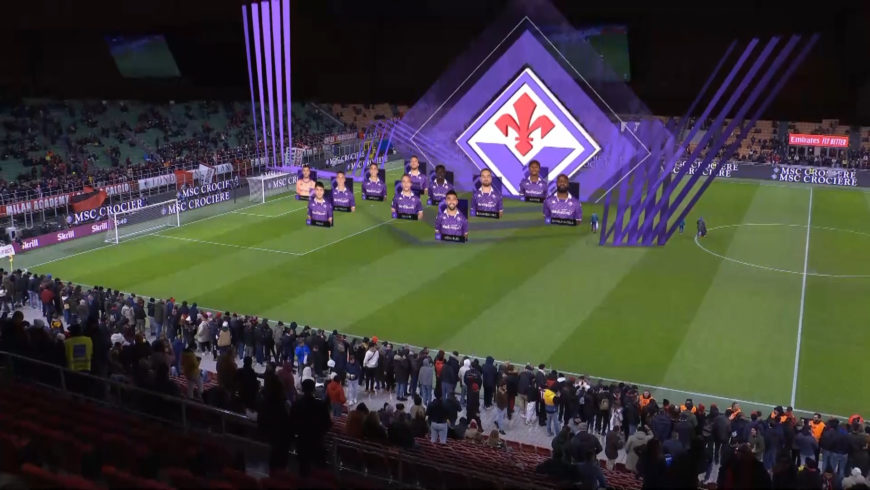
Another test that had to be carried out and gave very positive results is related to the actual lack of reference points typical of the football field. Here, the “continuous” green of the grass prevents the placement of markers on the floor, typical of the studio setting. In similar systems, it is precisely the markers, kept out of the frame, that make it possible to precisely track and synchronize the graphics with real elements; while here, it is not possible to place any because they would be visible in the movements. This makes the preliminary calibration part much more complex, as the grass field is typically a continuous expanse of… green.

In this test, the camera was located to the left of the field, on the longer side, and a couple of typical usage situations were chosen: inside a small set on the field, as in the typical unilateral commentary position with a micro studio and guests, perhaps for the integration of the local broadcaster. And also in the typical walk of the journalist along the field.
The final effect
Instead of the usual overlay graphics, augmented reality makes the inserts on stage more spectacular, as if they were autonomous elements on the field, becoming another protagonist alongside the talents and players.
Cups, statistics, shields, line-ups, coaching assistance in the pre-match, and a thousand other “concepts” come to life and can move in perfect synchrony with the talents commenting on the highlights and who, in turn, can be static in a commentary position or walk along the field edge. These shots are ideal in moments of game stops, during substitutions, or in a corner kick, and become a driving element from an editorial point of view, flexible and highly creative in the hands of a capable director.

The technique in detail
Tommaso Gargaro concludes, “The Ncam machine acts as a tracker and manages all the aspects related to motion by identifying where the camera is in the shots. Then it transforms the visual information into position metadata relative to the external environment and represents them with coordinates in a three-dimensional space.”
To do this, it uses two micro-cameras alongside the main camera, therefore, in a stereoscopic configuration, installed on the shooting support, in this case, the steadicam. The system is able to interpret reference points in real space and recreate metadata to manage the real image tracking, performing the magic with only six frames of latency. The operator is able to see in the viewfinder the live return of the graphics added to his real images, to make his movement perfect, for example, in a walk ahead. The test is the first of its kind as the Ncam system has already been used on cameras with fixed support in the studio, therefore in the presence of other equipment already capable of generating references in space using markers. In that case, it did not need to track the camera position in real-time, as it happened here where there is no need to place markers on the scene.
The expert director, Angelo Carosi
Angelo Carosi, an experienced and talented television director who has helped make Serie A one of the most spectacular and engaging football championships in the world, was present in the field to follow EMG Italy’s test. Here is his opinion.
“Considering that every graphic, even dynamic, is still partly static,” says Carosi, “we welcome this system that seemed very interesting to me because live, and I think its potential will increase even further with future integration with artificial intelligence. It is very interesting both in the international generation of the host feed and – perhaps above all – in the unilateral feed that the broadcaster wants to stand out and propose even in multi-platform broadcasts. I believe that excellent pre-production work and graphic taste are really essential to make the most of this innovation, also in light of the investment, now very accessible, required for those who must and want to innovate.
Today, content producers or broadcasters must always offer something elite to discourage the subscriber churn rate. Moreover, regarding the multi-platform streaming broadcast, it is potentially possible to customize each feed and make it unique for different user groups. In practice, I believe that this AR system allows the “customized” development of content through personalized graphics, which, thanks to careful and close work with the editorial team, makes such content even more unique for each customer. As such, I see truly great potential certainly in football but also in other sports.”
© 2023 Presspool PressOffice RobertoLandini
Once again this year the Serie A basketball championship ended with the playoffs between the strongest teams of the season and with the best-of-seven championship final formula. The final clash, between Olimpia Milano and Virtus Bologna, saw the Milan team triumph only in the last match, held at the Assago Forum on 23 June in a very spectacular way, both from a sporting point of view and from a tv filming point of view .
EMG Italy, which has been collaborating with the LBA for broadcast services for about 6 years, in the last season took care of the TV production of the major basketball championship, with particular attention to the filming of the Playoff matches, broadcast free to air on channel Nove, on pay-TV on Eurosport and, in streaming, on the Eleven Sports and Dazn platforms.
Production methods
“For EMG Italy I follow basketball, Serie C, volleyball and youth football and coordinate a series of producers who deal directly with the various championships”, says Paolo Sassano, Sports Production Coordinator of EMG Italy. “I can say that the whole LBA basketball championship this year was exciting and the final was “very tight” and decisive, also because it went all the way to the last match, with a “3 to 3” on game 7, the race that was supposed to award the title”.
This season was managed in a hybrid mode, partly with mobile vehicles on site in the various arenas and partly in remote production for a certain number of matches.

Paolo Sassano says: “This season we have redesigned the basketball production set-up, trying to standardize the final product as much as possible for the user and, in agreement with the LBA, we have chosen to produce two or three games remotely out of the eight played every weekend”.
The EMG Italy Broadcast Center in Cologno Monzese, unique of its kind in terms of reception and distribution capacity, has already had an operational and technical structure for the remote production of many sports for some time and from this year, thanks to new investments, it was also expanded into basketball.
An Instant Replay Center dedicated to the LBA has also been created here, with 8 stations connected to the pitches, which allows the instant replay service to be centralized: upon request, the referees can review dubious game actions from different angles, at reduced speed, frame by frame or zoom.
Regular Season and Finals
EMG Italy has also created the host feed of all matches, eight rounds for thirty rounds in the Regular Season, for a total of 240 matches. To these were added another thirty play-off matches, to reach 270 games this season alone.
For the finals, which were all produced on site, some innovations were introduced to make the game on the pitch even more spectacular. The most important change concerned the refereeing, since for the first time the referees allowed to broadcast their audio commentary of the instant replay analyses.
The audio of these particular moments was recorded by a dedicated sound engineer, equipped with a microphone boom who accompanied the operator with a shoulder camera during the game. In the event of an instant replay call, the sound engineer was therefore able to hear the audio of the two referees on the pitch, their arguments and requests to the instant replay operator.

The same sound engineer-operator pair was also busy capturing the images and audio of the coaches during the time out.

Ten cameras
The camera plan of the finals was particularly accurate, as the EMG director Max Ceriani supervised the positioning, together with LBA, with new proposals based on a higher number of cameras, precisely to improve the spectacularity of the images. The layout was therefore composed of ten cameras: the main one which followed the game with a total from the terraces of the stands above, flanked by camera 2 which covered the details and narrow pitches of the game.
The setup also included three shoulder cameras, one central and two positioned under the basket as well as 2 remote micro-cameras high up on the basket backboards. A 13-metre jimmi-jib positioned behind one of the baskets (based on the available space and escape routes) created new and dynamic shots, following the entire match and creating horizontal and vertical movements.
A reverse camera filmed the benches, close-ups of the referees and close-ups of the VIPs in the opposite grandstand. Finally, a further handheld camera with cinematic optics, mounted on a gimbal support with an RF system was free to move around the court and in the stands to capture filler shots and as many details as possible.

The TV Compound
All television production was entrusted to EMG Italy, whileand Infront, a partner of Lega Basket Serie A, was responsible for distributing the signals abroad by adding a commentary in English created in the production center in via Deruta in Milan.
The main direction of EMG Italy equipped with 4K HDR cameras created, in this case, an HD feed. In addition to the host signal, an integration was also produced for the Warner Bros. Discovery group channels (Eurosport and Nove). The TV compound also included another truck as a support means, a generator set and the integration mobile van for Warner Bros. Discovery. The graphics, created by EMG BOOST Graphics division, provided for a station located on the long side of the field, and developed a new presentation of the starting quintet of the players before the start of the game with the line-up on the field.
“The personnel of these productions”, continues Paolo Sassano, “usually are engaged in the setup from the day before the match. However, we often find ourselves creating a setup that would require eight hours of work less than four, because the arenas are always busy. On average, we usually need at least six hours of setup with a 25-person crew.”

Anna Pasculli Sales Manager of EMG Italy: “It was certainly a year of great success and great changes for basketball TV production, where we introduced several important variations. For the first time in Italy, on a sport other than football, we launched the centralized and remote service with the Instant Replay Center in Cologno Monzese. It is extraordinary, because from a centralized location it is possible to supervise everything that is managed by the on-site referees. Just as the main international broadcasters around the world are exploiting cloud-based remote production every day for high-value content – centralized and in real time – also EMG Italy, thanks to our remote production hub in Cologno, is today a consolidated reality.
We started with the “remi” from the lower standard to then extend it to basketball in standard A and we are confident that we will continue to carry out this project which will allow us to control and manage all the productions from the courts. The idea of the “remote” for EMG Italy is precisely this, to have centralized control and a much greater fluidity of the processes. These are tangible advantages that translate into greater uniformity of productions, greater standardization and therefore a less artisanal and more complete product possible, usable for the passionate television audience.
In this way it is possible to create a “running order” which is respected on all lots: there is a global vision and the customer, being comfortable in the production center, is able to see all the fields and if necessary can make changes, when and where necessary, while we can supervise the product and meet continuity expectations”.
© 2023 Presspool PressOffice RobertoLandini
