Key industry players collaborate for top-tier Serie A coverage
The San Siro Stadium was chosen for a pivotal test on the feasibility and quality of 4K UHD in live sports production, using a new setup. For the first time in Serie A, the Milan-Udinese match on Saturday, 19th October featured two Hitachi UHD7000-S11 cameras, part of a full 4K UHD production chain in Rec. 709 standards. This innovation introduced new viewing angles compared to traditional shots, leveraging the Hitachi 4K UHD cameras.
The Team
This trial was achieved thanks to the collaboration of multiple companies, each playing a crucial role in coordinating efforts to reach the goal. Milan, as the producer of home matches, worked alongside Lega Serie A, which authorised and supervised the project, managing Serie A production from the IBC in Lissone.
EMG Italy, responsible for the match and several Serie A productions, deployed its flagship mobile unit, the Nova 128, along with a production team. CVE, importer of Hitachi and Domo Broadcast Systems products, contributed with camera equipment and an RF transmission kit from the two respective brands. This integration of technology and expertise allowed for a successful test of 4K UHD in a high-level sports environment.
The Setting
San Siro Stadium, recently upgraded with a fibre optic infrastructure by EMG Italy, provided the ideal setting for this trial. One of the two Hitachi cameras was shoulder-mounted, allowing extensive movement along the left touchline and offering goal-line shots in RF mode. An embedded Domo Broadcast system in the camera transmitted an HEVC 1080p signal, received by a set of antennas and then routed via fibre optic to the mobile unit. The second camera, using a standard SMPTE chain, recorded UHD footage and relayed it to the EMG Italy mobile unit’s CCU. Strategically positioned at 45° along the length of the field near the benches, this camera was mounted on a tripod for optimum coverage.
EMG Italy CTO
“The test yielded very positive results,” says Francesco Donato, CTO of EMG Italy, “both for image quality and fluidity, perfectly integrated into our OB Truck Nova 128 workflow.”
General Manager of CVE
“Hitachi,” emphasises Mauro Contursi, CVE’s General Manager, “has long offered a proven studio broadcasting technology, but this is the first time in Italy that we have been able to showcase the HD7000 cameras in the field during Serie A. The 4K UHD solutions proved perfect for live broadcast, with one camera, in particular, used wirelessly thanks to an integrated transmission board developed by Domo Broadcast Systems.”
Optics
“Both lenses selected were FUJINON,” comments Francesco Spisti, Head of Sales & Marketing at Fujifilm. “We opted for a UA107x8.4BESM-T45 box lens, balancing focal range and performance, mounted on the SMPTE camera. The shoulder camera used a UA22x8BERD-S8 ENG lens, ideal for realistic, high-quality 4K video production. Both lenses included full servo controls for precise zoom and focus.”
Head of production
“Using a shoulder camera in constant motion across the field,” says Giacomo Gatti, Head of Production at EMG Italy, “usually strains compression systems, producing artefacts. However, the Hitachi camera handled the stress well, delivering image quality without visual interference. Moreover, the RF section must ensure stable transmission in motion, which is not always the case. Here, the camera maintained signal stability, even within the tunnel, which other RF links have struggled with. The tunnel, symbolising the final moments before match kickoff, proved to be no issue for the embedded Domo Broadcast board in the Hitachi 7000, showcasing remarkable reliability. This gives directors greater operational confidence. Additionally, we managed colour control remotely via the panel, even for the radio camera, allowing video parameter adjustments directly over the radio link.”
Carlo Maria Di Tullio concludes: “As self-producer for our Campionato and Coppa Italia matches, AC Milan remains committed to advanced broadcasting technology to continually enhance the quality of content and viewing experiences for fans. In a competitive Serie A landscape, technological innovation is essential to deliver broadcast experiences that meet modern expectations with increasingly engaging, interactive content. The San Siro trial aligns perfectly with AC Milan’s vision of consistently exploring solutions from advanced cameras, immersive graphics, and real-time analytics to AI and machine learning to optimise production and workflows. These innovations aim to deliver a top-tier TV experience, aligning with the needs of today’s fans who expect highly interactive, customisable content accessible on multiple devices.”
© 2024 Presspool PressOffice RobertoLandini
EMG Italy completely renewed the infrastructure of the San Siro stadium, one of the symbols of Milan and Italian football
The Giuseppe Meazza Stadium, a tribute to the legendary Italian footballer, also known as “San Siro” from the Milanese district where it stands, is the largest sports facility in Italy and the second largest in Europe in terms of capacity.
Inaugurated in 1926, it is owned by the Municipality of Milan and managed through the company “M-I Stadio”. Today it seats 75,923 with the two teams AC Milan and FC Internazionale, who use it to play their matches.
In addition to concerts and religious events, it regularly hosts the Serie A TIM football championship, the Coppa Italia, the Supercoppa Italiana, the Champions League, the Europa League, the World Cup and the European Football Championships. Following an intense commitment, first for the design and then for the construction, EMG Italy completed, a few months ago, the complete renovation of the now dated audio/video/data infrastructure of the San Siro Stadium, also known as “La Scala del Calcio” for its beauty and prestige.

The work began at the end of the 2022-23 top-flight football championship and kept the technicians and companies involved busy for over five months, leading to the testing of the solution in mid-November. The new and advanced technological infrastructure was used for the first time on 2 December 2023, during the television production of the Serie A football match Milan-Frosinone.
“We have redesigned the entire infrastructure,” says Francesco Donato, CTO of EMG Italy, “with this project we have updated the systems not only by adapting the wiring to current technological standards, but we have also thought about it in light of the new filming formats, which require a different and more current configuration of the filming stations. The narrative of our days is certainly aimed at the maximum spectacularization of the sporting event and therefore we have implemented new solutions and positions previously available only through additional temporary systems.
Then, to make the connection with the filming equipment located at the TV compound easier, we have designed and installed all the terminations and active devices in a special container to allow the best connectivity to and from the stadium, in addition to having implemented control solutions to verify the functionality of both the active and passive components that make up the system infrastructure. The new solution, therefore, allows for the creation of productions that are significant from the point of view of narrative and technological complexity, favoring a rapid process of installing the filming stations as well as everything necessary from the point of view of reporting and interviews”.

New setup
The new setup has created 23 new shooting positions inside the stadium, plus an additional termination point for the cabling that is inside the container in the TV compound.
The cabling of the shooting positions was created with SMPTE cables and dark fibre for all positions, and active equipment was installed in some positions, both for the transport of video signals and audio signals. Finally, for some of these positions, copper connections were also created, to be considered only and exclusively as a reserve system. The system was also designed to allow a good degree of scalability, to guarantee a possible temporary expansion, should it be necessary to implement large-scale shooting configurations.
“There’s more,” adds Francesco Donato, “the new infrastructure was created in such a way that it will eventually be possible to carry out television production also in “reverse” mode and therefore, if required, it would be possible to carry out two simultaneous productions with great advantage from a commercial point of view, since the visibility of the sponsors would be doubled”.
EMG Italy, as project manager, carried out all the engineering of the project and meticulously followed the physical implementation carried out by CRV Sistemi di Nicola Carvelli, with the contribution of Professional Show which supplied the active components of the system.
Some numbers of the system:
• 30 km of cable between SMPTE and Dark Fiber
• 60 SMPTE camera points
• 200 dark fiber connections
• 82 SDI to Fiber and Fiber to SDI video trunks
• 210 Audio to fiber and fiber to audio
• 30 trunks with media converters

Double safety
“One of the fundamental objectives of this project”, adds Simone Sofia, Technical Resources Manager who personally followed the implementation, “was to guarantee the total safety of the system, which we wanted to be truly double and complete.
This means that first of all the cable routes between the shelter and the wall box were studied in particular, taking care to prepare dedicated passages and avoiding crossing old cable ducts. Furthermore, there was particular attention to the redundancy of the electrical supply, so that any event can take place without the slightest risk of discontinuity in the service.
The power supply, in fact, is double and is supplied to the shelter and the wall boxes both by a protected network with an electrical cabin owned by the stadium, and by hooking up the generator, when it is used in events. The same applies to the prevention of malfunctions due to possible excessively high temperatures. The shelter where all the connections end, positioned in the TV compound, operates at constant and controlled temperature and humidity.
All the wall boxes are also equipped with internal ventilation that manages and maintains constant the temperature, when necessary, in order to safeguard the machines contained even in the case of beating sun, avoiding possible blockages of the equipment due to excessively high temperatures.
All this is managed by EMG both in maintenance and in daily management, entrusted to a technical supervisor who, in addition to assisting the broadcasters in setting up the events, coordinates the entire active part of the system from a dedicated control station inside the shelter”.
The advantages: reliability and speed of set-up
The new system provides a great advantage both in the set-up phase and in terms of operation, then, last but not least, it is completely modular and adjustable both in terms of use and in terms of flexibility.
Francesco Donato concludes: “I would like to remind you that this new configuration also prepares the sports facility to facilitate a possible technological implementation, to develop “on-venue” communication and entertainment strategies and to promote new service systems, such as the adoption of 5G technological solutions that allow the capture and dissemination of special content dedicated to the entertainment of the public”.
© 2024 Presspool PressOffice RobertoLandini
In recent years, technology has made enormous strides, transforming the way we interact with the surrounding world. An innovation that has literally captivated everyone is Augmented Reality (AR). It has revolutionized various industries, from gaming to entertainment, education, and healthcare, and many believe the next frontier is live sports on television, where little has been done so far.
At the forefront of this technological revolution is EMG Italy and its specialized graphics department Boost Graphics, always at the forefront as pioneers pushing the limits of graphic technology. They are now exploring the potential of AR for augmented reality in sports.
“For the Milan – Fiorentina match on November 25,” says Tommaso Gargaro, the technical manager of EMG Italy, who led the event, “we tested AR in collaboration with the American company Ncam (now part of the Zeiss group) and the Italian distributor Video Progetti, a company at the forefront of innovation in Virtual Production and Augmented Reality with a team of specialists made available ‘on the field’ during the tests.

We conducted this test at the San Siro stadium in Milan with the intention of adding Augmented Reality (AR) in a “real” on-field condition and verifying the potential of these technologies to enhance the television product without interfering with the normal shooting setup. We also invited Serie A director, Angelo Carosi, to assess the opinion of a great expert on this new frontier of entertainment, capable of seamlessly combining live actors and three-dimensional graphic content in motion with the scene. The goal was also to assess the extent to which these effects can enrich the graphic landscape of sports, starting with football, and verify its live technical feasibility.”
Ncam technology was used in combination with the Vizrt graphics engine to evaluate the accuracy of real-time tracking in the scene and the system’s stability in complex conditions such as a football stadium. Virtual elements (3D graphics) were created ad hoc and aimed to enrich the narrative of the sports event by adding data and statistics. The system was based on a Sony 4300 camera in one of the typical configurations used in football matches and many sports events, with a Canon 12X lens.

Precision and reliability
“The results of the test were promising from a technical point of view,” says Tommaso Gargaro. “Ncam technology was able to provide precise and reliable real-time tracking, even in the presence of strong light contrasts or moving objects and subjects, as in the case of the journalist’s walk along the field. In particular, the test showed that Ncam technology is capable of:
• Precisely tracking camera movements, even in the presence of strong light contrasts or moving objects.
• Overlaying virtual graphics realistically and without distortion.
These results indicate that, in our opinion, Ncam technology has the potential to be used in new augmented reality applications in sports and television. In particular, it could be used to create new viewing experiences, such as overlaying live statistics or virtual images but with a decidedly innovative look.”
The test
In some ways, football offers the best opportunity to test the system because the shooting condition is a bit more critical here, given the size of the fields, compared to other sports where the arenas and work areas are smaller and usually uniformly lit. The “discontinuous” lighting could indeed challenge the system, which fundamentally generates real-time tracking of images with respect to 3D graphic elements.
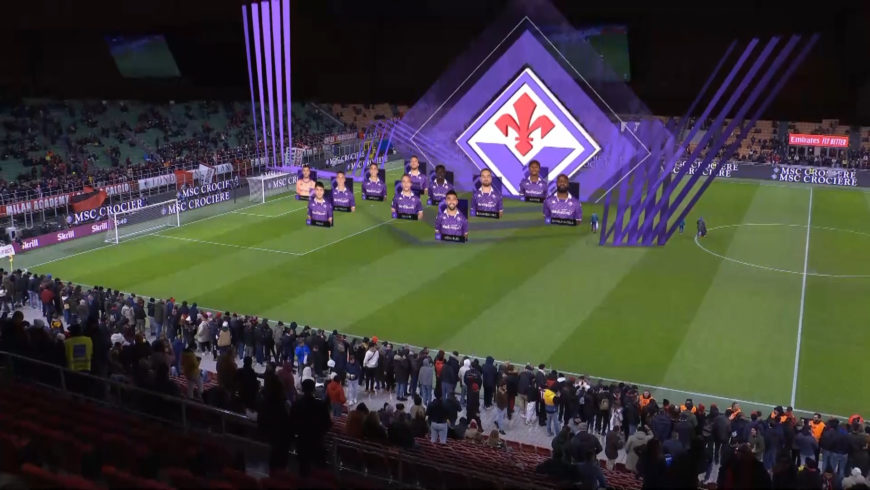
Another test that had to be carried out and gave very positive results is related to the actual lack of reference points typical of the football field. Here, the “continuous” green of the grass prevents the placement of markers on the floor, typical of the studio setting. In similar systems, it is precisely the markers, kept out of the frame, that make it possible to precisely track and synchronize the graphics with real elements; while here, it is not possible to place any because they would be visible in the movements. This makes the preliminary calibration part much more complex, as the grass field is typically a continuous expanse of… green.

In this test, the camera was located to the left of the field, on the longer side, and a couple of typical usage situations were chosen: inside a small set on the field, as in the typical unilateral commentary position with a micro studio and guests, perhaps for the integration of the local broadcaster. And also in the typical walk of the journalist along the field.
The final effect
Instead of the usual overlay graphics, augmented reality makes the inserts on stage more spectacular, as if they were autonomous elements on the field, becoming another protagonist alongside the talents and players.
Cups, statistics, shields, line-ups, coaching assistance in the pre-match, and a thousand other “concepts” come to life and can move in perfect synchrony with the talents commenting on the highlights and who, in turn, can be static in a commentary position or walk along the field edge. These shots are ideal in moments of game stops, during substitutions, or in a corner kick, and become a driving element from an editorial point of view, flexible and highly creative in the hands of a capable director.

The technique in detail
Tommaso Gargaro concludes, “The Ncam machine acts as a tracker and manages all the aspects related to motion by identifying where the camera is in the shots. Then it transforms the visual information into position metadata relative to the external environment and represents them with coordinates in a three-dimensional space.”
To do this, it uses two micro-cameras alongside the main camera, therefore, in a stereoscopic configuration, installed on the shooting support, in this case, the steadicam. The system is able to interpret reference points in real space and recreate metadata to manage the real image tracking, performing the magic with only six frames of latency. The operator is able to see in the viewfinder the live return of the graphics added to his real images, to make his movement perfect, for example, in a walk ahead. The test is the first of its kind as the Ncam system has already been used on cameras with fixed support in the studio, therefore in the presence of other equipment already capable of generating references in space using markers. In that case, it did not need to track the camera position in real-time, as it happened here where there is no need to place markers on the scene.
The expert director, Angelo Carosi
Angelo Carosi, an experienced and talented television director who has helped make Serie A one of the most spectacular and engaging football championships in the world, was present in the field to follow EMG Italy’s test. Here is his opinion.
“Considering that every graphic, even dynamic, is still partly static,” says Carosi, “we welcome this system that seemed very interesting to me because live, and I think its potential will increase even further with future integration with artificial intelligence. It is very interesting both in the international generation of the host feed and – perhaps above all – in the unilateral feed that the broadcaster wants to stand out and propose even in multi-platform broadcasts. I believe that excellent pre-production work and graphic taste are really essential to make the most of this innovation, also in light of the investment, now very accessible, required for those who must and want to innovate.
Today, content producers or broadcasters must always offer something elite to discourage the subscriber churn rate. Moreover, regarding the multi-platform streaming broadcast, it is potentially possible to customize each feed and make it unique for different user groups. In practice, I believe that this AR system allows the “customized” development of content through personalized graphics, which, thanks to careful and close work with the editorial team, makes such content even more unique for each customer. As such, I see truly great potential certainly in football but also in other sports.”
© 2023 Presspool PressOffice RobertoLandini
The Euroderby semi-final of the Champions League between FC Inter and AC Milan on 16th May saw international television production by EMG Italy for Mediaset, licensee of the UEFA event and holder of the rights to the match.
For the occasion, the EMG Group was also present at the TV compound with the ob vehicles of EMG Belgium and EMG UK, committed to other broadcasters, but in synergy with each other with a view to a collaboration that increasingly improves the efficiency of each productive process.
The technique in the field: Michele Iorio, OB Production Manager
“EMG is the television service of Milan and Inter for the football championship”, says Michele Iorio, OB Production Manager of EMG Italy. “I am the producer who mainly follows Serie A football, fixed in Milan on all Inter and Milan matches for the championship, the Italian Cup and the Champions League for Mediaset. As an accountant for the AC Milan and Inter clients, I follow them for all stages of production. According to the three typical standards A,B,C, I select the necessary personnel respecting the production budget and I also follow the unilateral integrations, with accreditations, logistics, and relations with broadcasters, also towards national and international takers”.
The setup in the Champions League
The set-up as regards the host broadcaster production begins two days before the match, from the audio-video stations, with a reduced crew. On “match day -1” the first tests are usually carried out with training from the away team plus press conferences and flash station interviews, which did not happen on this occasion as the two teams met the day before the match they are trained at Milanello and Appiano.
Preliminary tests were carried out on the LED walls inside the stadium and on the entire audio-video technical circuit. In fact, the San Siro facility is semi-permanent and is set up at the beginning of the season in August, to remain in place until the end of the championship.

The Euro Derby
Mediaset broadcast the derby on Canale 5, entrusting the production to two large OB Trucks, the EMG Nova 103 unit in charge of international host production and the Nova 128 which carried out Mediaset’s customized national production.
The technical team fielded for the host feed was led by Mediaset director Giorgio Galli and his assistant Stefano Schiavinato. The host director’s technical crew consisted of 5 camera controls, 1 video mixer, 7 EVS operators, 1 RVM operator, 5 audio assistants, 2 chief technicians, 2 sound engineers, 5 machinists and 1 production manager, plus 21 operators for 22 cameras. Twenty-three people were instead hired for the unilateral production of Mediaset, and included a producer, a technical chief, two sound engineers, a video technician, 3 stagehands, a camera control, a video mixer, two EVS operators, 4 camera operators, 5 microphone operators , led by Mediaset director Marco Di Francesco.
Other unilateral integrations
In the TV compound, next to the stadium, there were also two other large mobile control rooms: the EMG Nova 119 and EMG Nova 102, as we said, responsible respectively for the production of Amazon Prime Germany and the British BT Sport.
In addition to the 22 cameras for the host feed, a drone was used, plus two other cameras dedicated to the multi-pitch and flash locations (path 1 and 2). The two positions on the pitch in the pre-match and in flash post-match were dedicated to international multi-feed customizations and enslaved to numerous foreign TV channels holding the rights which alternated in interviews for 10 minutes each, in rotation.
More news
“It was very exciting to see 4 international production vehichles from the group working together”, underlines Michele Iorio, “and to see the football that counts in Milan again, in a very special evening. Among the peculiarities of this event, to involve the public even more, Mediaset set up an RF room outside the stadium to collect all the emotion of the fans live. Furthermore, to make the most of the atmosphere of the evening and the spectacular nature of San Siro, a drone was also used which flew in well-defined areas, and captured a different perspective from that of the cameras on the pitch. To further enrich the event and return the excitement of the stadium to the audience at home, the audio was recorded entirely in Dolby Atmos. Among the supports for special filming, two back-of-the-door polecams were used, two steadycams, to the right and to the left of the field, which filmed the arrival of the teams and accompanied the players in the corridors before the changing rooms. The replays were enriched by 5 Sony Super Motion cameras”.
© 2023 Presspool PressOffice RobertoLandini
