The Free University of Bozen led an experimentation (5VREAL) on systems using AI to recognize phases and parameters of play in Volleyball and to generate data associated with video to be used either at a strategic level (supporting the development of game tactics) or to increase fan engagement (Fan engagement) by producing highlights with real-time augmented reality graphics for inclusion in the event’s TV program.
As part of this experimentation, 5G network-based remote broadcast production techniques and technologies played a twofold role. The first, to make possible the capture of images and their transfer into the Edge Cloud that hosts the AI-based systems. The second, to enable the creation of real-time highlights and make them available for playout at the director’s office.
The 5VREAL project was the recipient of a MIMIT call aimed at promoting the use of the 5G network and computing resources in proximity data centers (Edge Datacenters or MECs) for audiovisual production and applications employing artificial intelligence.

The Free University of Bozen/Bolzano was the leader of a grouping of institutions and companies engaged in the development of technologies useful for achieving the goal. In particular, the Bruno Kessler Foundation (FBK) and UniBZ were involved in the development of artificial intelligence-based systems for analyzing game phases. Small Pixels developed and made available their AI-based technology for improving the video quality of content that has undergone compression processes. Taking advantage of the capacity and flexibility of its 5G network, Vodafone installed dedicated indoor coverage at the Trento sports hall to ensure the necessary performance for the mobile devices deployed there. It also built a private network that would allow them to connect with the Edge Computing resources set up inside EMG Italy’s MCR in Cologno Monzese.
EMG Italy built the entire technological infrastructure of the datacenter, made its production facilities available and oversaw the implementation of a low-latency remote contribution and production system based on what Vodafone has already experimented with its 5G Remote Media Production Platform.
The result of the trial was demonstrated at an event at The T-Quotidiano arena (sports hall in Trento). The comprehensive process set up by the partners allowed a volleyball match to be filmed with 4 cameras connected both in 5G to the remote production system at the edge datacenter in Cologno and to the Nova 126 mobile unit. In addition to the Broadcast cameras, the event was filmed with 3 Smartphones, also connected in 5G to the Edge Cloud in Cologno, to demonstrate the possibility of having all the AI-based tracking part even when the event is not produced for TV broadcast.
The result of the AI-based systems’ processing was displayed on a tablet where, in addition to the event video, game data extracted from the systems were scrolled through, while augmented reality-enriched clips were inserted into the event program in the form of highlights. The extracted data and generated content could also be consulted after the event for game analysis useful for developing game strategies.

Vodafone’s 5G Remote Media Production Platform and EMG Italy’s expertise
The trial thus benefited from the 5G network solution developed by Vodafone for remote video contribution and production applications, which was extended by adding the Edge Computing node built at EMG Italy’s Cologno Monzese MCR datacenter. In order to benefit from maximum performance in terms of low latency and reliability, the Edge Computing infrastructure has been made directly accessible from devices enabled on Vodafone’s 5G network through a direct and virtually dedicated connection.
In this way, devices equipped with special SIMs (not commercial SIMs, to be clear) benefit from advanced features such as network slicing, which reserves the necessary resources for them to have a relevant amount of bandwidth (especially in upload) and extremely low latency levels. Without these resources, they could not enable the transmission over wireless networks of high-quality video streams in real time.
Moreover, such devices benefit from a direct and dedicated connection, almost as if “there was a direct line” between the indoor coverage equipment in the arena and EMG’s Edge Cloud.
All thanks to the large capacity and advanced capabilities of Vodafone’s 5G infrastructure. In order to maximize the performance of its network for audiovisual contribution and production uses, Vodafone contributed to the development of dedicated devices that were acquired and managed by EMG Italy for the occasion.
These devices, which can be likened to “backpacks” commonly known in the broadcast industry, represent an “extreme” evolution of it in that, in addition to possessing audio/video capabilities superior to what is available on the market today, they add to technologies such as bonding a precise integration with the operator’s network.

The result is that, regardless of where in Italy one connects via one or more SIMs, data will arrive at the data center in Cologno Monzese in an average time of about 15 milliseconds without traversing the Internet and therefore without being impacted in terms of bandwidth availability and latency. In practice, what will impact the characteristics of the link (bandwidth and latency) will only be the quality of the radio access, which, however, is improved thanks to the characteristics of the terminal. In fact, the latter, in addition to being equipped with 5 latest-generation 5G network interfaces, also benefits from a case design designed to optimize radio performance. This is because, despite the benefits derived from the specific integration of the device into the network and the dedicated resources at the access level, the device plays a key role in that it must be able to take advantage of capabilities and technologies made available by the network in order to be able to perform very well.
In the course of the experimentation, and particularly in the Trento event, exceptional access performance was verified that allowed the terminals to have connectivity with more than 700Mb/s download and 100 Mb/s upload and with transport latencies always below 20ms.

The result is that, regardless of where in Italy one connects via one or more SIMs, the data arrives at the data center in Cologno Monzese in an average time of
Video contribution latency, thanks to the encoding and decoding performance of the devices and systems in the datacenter is always less than 150ms thus enabling the realization of any contribution or remote direction activity.
The experimentation also benefited from the technology made available by Small Pixels, which, thanks to its software developed together with the University of Florence and based on pre-trained artificial intelligence neural networks, allows for a clear increase in video quality with the same compression technology and available bandwidth.
In fact, the technology developed by Small Pixels proved crucial in eliminating visual artifacts such as pixelation, noise and distortion, on the contributions made by smartphones, helping to optimize both streaming and real-time transmission. This made it possible to use streams generated by ordinary smartphones to feed the UniBZ and FBK systems dedicated to game data analysis and ball tracking, as well as for all subsequent data interpretations.
The infrastructure created in EMG Italy’s datacenter in Cologno represents a consolidated asset that lends itself to future evolutions for the provision of new services similar to those implemented during the trial, namely: Remote Production, On-site Wireless Production, Video Analysis on AI-based systems, augmented reality content generation, etc. All with the simplicity and speed of deployment resulting from mobility over a 5G network.
“On the infrastructure of EMG Italy and Vodafone,” emphasizes Luca Bertoldi IT Manager of EMG Italy, “advanced solutions have been developed that allow to manage a director or MCR directly from remote locations, offering also the possibility to operate a mobile director.
It is enough to have an access point to Vodafone’s 5G network to control a direction and manage 3-4 cameras efficiently.”
Luca Sampietro, Product Marketing Manager 5G Vertical Solutions at Vodafone points out that “we have worked side by side with EMG Italy and the other members of the grouping not for the purpose of pure experimentation, but because we are confident that 5G can contribute strongly to innovating the broadcasting industry in a structural way.”
On Site Wireless Production
This is an adjunct workflow to remote production where, direction is done on handheld devices connected to the 5G network. The typical application could be for sporting events that take place outdoors and would be expensive to produce using traditional methods where the use of the program is more than just broadcasting. A typical example might be a mountain bike race where the organizer wants to have strong on-site audience engagement through ledwalls but also wants a streaming broadcast. A remote production solution would bring few benefits compared to using an OB truck, which would still be expensive. With this solution, taking advantage of the virtualized control room in the datacenter, cameras scattered around the competition grounds send signals that are displayed in real time on tablets (or notebooks that may also have dedicated control panels) from which video mixer, audio mixer, graphics, and clip contribution is managed. The program can thus be sent to both the streaming platform and the ledwall via a 5G device with SDI/HDMI/IP inputs and outputs.
 The edge infrastructure currently available in the EMG Italy datacenter could safely handle up to 6 to 8 multi-camera events in different locations, with the signals carried via mobile devices specifically developed for Vodafone’s MMPP.
These systems, in addition to providing extremely low latency that allows for remote event direction, include broadcast-specific features such as multiple 12G SDI inputs and outputs to handle up to 4 video inputs or more than one video return simultaneously with 2 4K inputs for each device, along with two intercom circuits and other audio inputs/outputs; essential features for use in the broadcast environment.
Each device integrates five 5G modems and a high-performance encoding and decoding engine, capable of achieving encoding latencies of ½ frame.
EMG Italy’s platform design was overseen by Luca Sciotti, who has been active in supporting Vodafone in the development of the 5G Remote Media Production platform and mobile devices for several years now.
His comment on the sidelines of the trial results was, “These are solutions that, as they grow along with the coverage and performance of mobile networks, open up new production scenarios or improve the processes of existing ones. One thinks of the possibility of using these high-performance devices even in the studio where they can guarantee superior performance in terms of functionality, quality and latency to those of traditional radio camera systems, or the possibility of managing the production of an event totally on site without the need to move the expensive and cumbersome means that remain indispensable for high-level productions anyway.”
Contribution
Among the distinctive features of 5G Remote Media Production is the ability to allow point-to-point contribution anywhere, even between non-professional mobile devices, albeit high-end ones. Let’s not forget that the latest iPhones have very high video quality and are already used today for some journalistic contributions.
Unlike other solutions on the market, in fact, devices combined with cloud servers and other infrastructural components are not required. 2 devices and a connection are sufficient to allow the exchange between them of 4 video signals in total (even UHD), service communications and control signals, etc. All with latencies that stand at 150ms point-to-point and high reliability due to the fact that you are in all respects on a dedicated portion of the network.
© 2025 Presspool PressOffice RobertoLandini
Airspeeder is the world’s first racing series for electric flying cars, or eVTOL craft (electric vertical take-off and landing). This brand new motor sport – which is part of the new aerial vehicle industry that is said to be worth £1.5 trillion in the next 10 years, according to Morgan Stanley – aims to come to market within the next two years, and already has craft in the air. To achieve its ambitious goals of becoming the ‘Formula 1 of the Sky’, Airspeeder needed a media technology structure that would enable live broadcasts that could be distributed globally, with high quality coverage to really engage worldwide audiences. The team approached EMG to solve the myriad challenges associated with live broadcasting on fast-moving aerial vehicles, as a proof of concept to move to the next stage of this exciting project. The ground breaking collaboration between Airspeeder and EMG marks a pivotal moment in the evolution of sports broadcasting, showcasing the potential of cutting-edge technology to redefine the viewing experience.
The Challenge
The project presented a unique set of challenges. Safety was of the utmost importance; currently the eVTOL craft are operated remotely, but the eventual plan is to have manned craft, so the safety of pilot and craft would be crucial. Available space inside the craft and the added weight of cameras, an RF unit and ancillary equipment would need to be considered. The races would necessarily take place in remote locations, so RF signal availability and reliable connectivity would also be key. Navigating the intricacies of live broadcasting from fast-moving aerial vehicles posed a challenge, necessitating meticulous planning and innovative solutions to ensure the safety of both onboard systems and spectators.
The Solution
An initial conversation at an EMG demo day about EMG Connectivity’s extensive broadcast experience with mini cameras in motor sports led to a ‘lightbulb moment’ for both companies. EMG Connectivity’s expertise in the RF domain together with Aerial Camera Systems’ (ACS) miniature camera technology seemed to be a perfect fit, so a visit to Farnborough, UK was arranged to look at how the equipment might be mounted on the eVTOL craft. The craft provided more than adequate scope and space, so EMG Connectivity designed a battery-powered RF on-board camera system around the Livetools Fusion HEVC transmitter and ACS’ mini cameras for initial testing at Airspeeder’s HQ in Adelaide, Australia.
Following a month of intensive camera and RF spectrum tests while safely on the ground, the aerial trial took place approximately an hour outside Adelaide in the desert. The Airspeeder team was most concerned that the Livetools Fusion transmitter would interfere with other RF or GPS systems or even the flight control systems on the craft, so the first test flight using a single eVTOL craft was a tense affair; but EMG Connectivity’s RF system proved reliable and free of interference with any other system, and the Airspeeder team was delighted with the live shots that were achieved.
The real test was at the Series Championship in December 2023, also outside Adelaide, with invited guests eager to see an aerial racing spectacle. There were three Airspeeder craft competing in the Series Championships, and the camera spec was to supply Airspeeder 1 with four onboard cameras and Airspeeders 2 & 3 with one onboard camera each.
At the heart of each Airspeeder was a Livetools Fusion HEVC transmitter transmitting simultaneous signals from each camera back to the Outside Broadcast facility. Along with the onboard cameras, there were also three filming drones – capturing the live in race action – successfully creating the world’s first simultaneous live broadcast of an aerial car race. As the world’s first live broadcast of aerial car racing unfolded, spectators were treated to exhilarating views captured by onboard cameras and filming drones in the sponsorship enclosure, showcasing the unparalleled thrill of this high-speed spectacle.
Chris Brandrick, EMG Connectivity Commercial Director says: “Participating in the world’s inaugural flying car race series is an extremely exciting project to be involved with. It’s not just about racing in the air; it’s about stretching the limits of possibility and embracing the excitement of innovation. Partnering with Airspeeder enables us to contribute to the evolution of this thrilling race series and continually explore new ideas.”
The Future
Following this successful proof of concept, Airspeeder and EMG’s specialist companies, EMG Connectivity and ACS, are excited to move on to the next phase. With Airspeeder technology still in its infancy, there is huge scope to adapt to challenges while maintaining safety as the ultimate priority.
ACS Sales Director, Matt Coyde, says “It’s been a great pleasure working with Airspeeder to bring the race series coverage from conceptual to live. We very much look forward to continuing our collaboration with them to further enhance the broadcast output of this exciting and unique aerial car racing series”.
Phase two includes fine-tuning camera mounts and tackling issues of power for more cameras and higher RF spectrum availability in remote locations. Another area of development will be the addition of broadcast graphics, which will provide the viewer with crucial information about races as well as Airspeeder craft and pilot information and statistics.
“Looking ahead, the successful proof of concept achieved by Airspeeder and EMG sets the stage for further innovation and deepening collaboration. Our relationship with EMG can only grow as we continue to explore new horizons in aerial racing broadcasting. Together, we envision enhancing camera mounts, expanding broadcasting capabilities to filming drones, and integrating live AR graphics to elevate the viewer experience. These unique live views will not only captivate sports audiences but also serve as a proof of concept for major advanced air mobility markets and modern air traffic control solutions for eVTOLs.” – Stephen Sidlo, Director of Media and Marketing, Airspeeder.
Aerial Camera Systems (ACS) and EMG Connectivity extend existing contracts and prepare for their biggest ever broadcast of The Championships at Wimbledon.
EMG Group companies Aerial Camera Systems (ACS) and EMG Connectivity (previously Broadcast RF) are delighted to announce a four-year extension of their contract with Wimbledon Broadcast Services (WBS) to be the specialist cameras and RF equipment supplier to The Championships, Wimbledon, staged by the All England Club’s annual Championships.
The two-week tennis event is one of the largest annual sports Outside Broadcasts undertaken in the UK and a huge project for all the companies involved. EMG Connectivity has supplied various broadcasters’ RF Services & Connectivity over several years but became the exclusive supplier of RF cameras when WBS took over the host broadcasting of The Championships from the BBC in 2018, while ACS has been involved on site for over 20 years.
“When we first started working with the BBC at Wimbledon we only supplied three or four camera systems. That provision has steadily grown and when WBS took over as host broadcaster they placed additional emphasis on creating unique shots of The Championships by placing more remotes around the Grounds to capture, for example, the crowd atmosphere and the players’ practice areas. This year will be our largest Championships delivery to date, with the supply of 46 SMARThead™ robotic camera channels and 26 operators supported by a small team of technicians and three on-site vision engineers,” comments Matt Coyde, Sales Director at ACS.
Broadcast standard compact robotic cameras are often preferred at the All England Club’s historic venue in SW19 as their unobtrusive nature minimises space requirements and line of sight issues making their use ideal within the confines of the Grounds. This year, the vast majority of camera systems are either UHD or 1080p HDR for the first time as WBS expands the high-quality format support from Centre Court out to all cameras at The Championships.
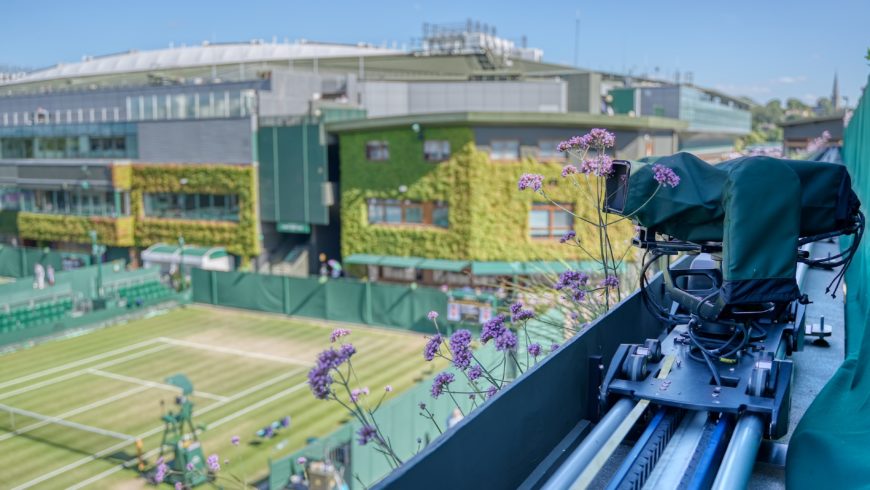
Centre Court itself features some notable specialist units including an ACS SMARThead™ mounted on a 10m railcam positioned along the baseline and housed within a purpose-built hide, whilst another four units are mounted on bespoke camera brackets designed specifically for Wimbledon, including two on the umpire’s chair dedicated to player coverage. In addition to the two tracks in Centre Court and No.1 Court, ACS is also supplying rail systems covering the Southern and Northern courts at the Club. As well as covering several angles of on-court play, numerous beauty cameras provide contextual coverage of the event and include remote crowd cams, coverage of the player arrivals area, Aorangi practice courts, and Media Theatre, plus topographic venue shots from a hoist-mounted GSS stabilised camera gimbal sitting high above the venue for the iconic overhead shots of the local area and London skyline.
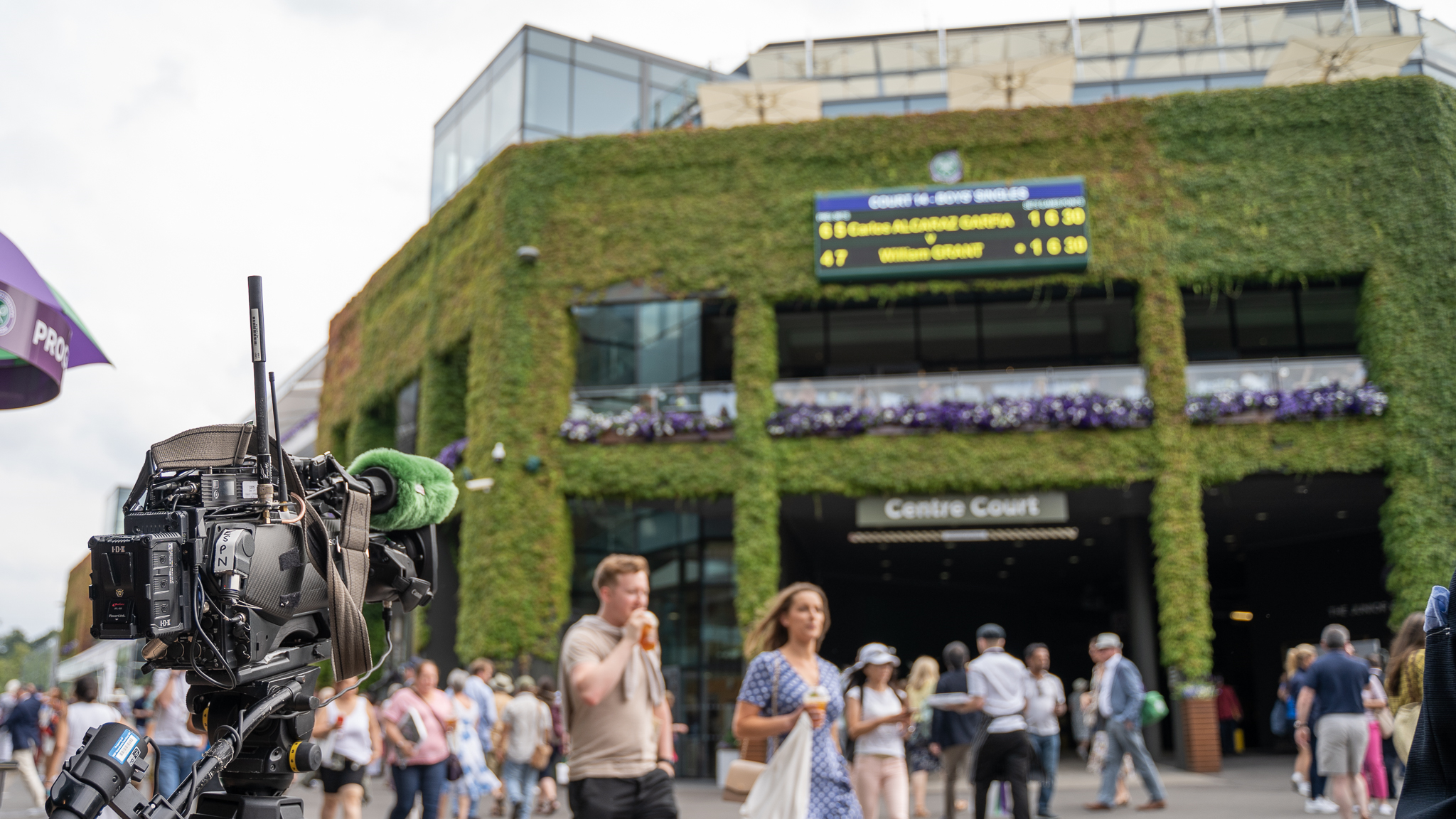
EMG Connectivity meanwhile is providing a wide range of kit and expertise to both the host and multiple unilateral broadcasters, supported by a crew of 6 for fortnight and more for the rig and de-rig of The Championships. There are 40 antennas site wide which feedback to a central RF cabin in the Broadcast Compound, switched and fed into their appropriate receiver units. This is a cost effective way of multiple area coverage for events such as Wimbledon and golf events such as the Open and the Ryder Cup. A wide area return video system for roving RF monitors is also provided to a number of broadcasters, allowing them to analyse footage from anywhere within the Grounds.
Walk of Champions:
One of the challenges for the EMG Connectivity team is to ensure smooth steadicam RF coverage of the Walk of Champions from the Dressing Rooms to the entrance of Centre Court pre-match. They also cover the champion from Centre Court up the stairs of the Clubhouse, through the corridor to the Dressing Rooms and onto the Members’ balcony to be greeted by the cheering crowd. This requires its own dedicated receive installation with antennas secreted within the walkways and corridors, providing seamless coverage within the building and in addition to the 40 antennas EMG Connectivity have around the Grounds.
“This is the first year that some of the RHBs have returned with onsite presentation to Wimbledon,” says Chris Brandrick, Commercial Director at EMG Connectivity. “It means we will be supplying more RF cameras and RF monitors than ever before. With our seamless wireless connectivity which unites the fans and the players, we are confident we can set the bar higher than ever before.”
“We are delighted to extend our relationship with ACS and EMG Connectivity as we continue to evolve our coverage to provide new standards of quality and innovation in the broadcast of Wimbledon” comments Paul Davies, Head of Broadcast, Production and Media Rights at the All England Club.
The Championships begin on Monday 3 July.
Move unites leading RF and connectivity divisions under one brand led by new international management team
Europe’s leading broadcast service provider EMG today announces that the RF Services & Connectivity in the Group will be united under the EMG brand. This means that the activities of Eurolinx, Broadcast RF and the RF activities of EMG France will be consolidated within a new business unit called EMG Connectivity. The new combination will, as global market leader, continue to deliver the bespoke customer service for which EMG is renowned all over the world. More than 1500 RF events per year are covered by the EMG Connectivity specialists including the most renowned sport events and entertainment shows of the world.
For several years, the various Connectivity business units have been collaborating and working as one at many major international events such as Tour de France and Giro d’Italia, the Olympics and FIFA World Cup, the European Championships in Munich, the marathons of London, Berlin and Vienna and many entertainment shows including Love Island and the BAFTAs. Clients working with EMG Connectivity will now be able to draw on the unrivalled knowledge and resources of the whole Group to integrate world leading solutions in remote production, IP technology, RF, satellite and 5G into their next production.
The new business unit will be led by an international team of EMG experts helmed by Bruno Gallais (Managing Director EMG Connectivity) who will hold this role alongside his work as CEO of EMG France. Gallais will be joined in the management team by Mark Houghton who will lead the UK business and will be Innovation Director for EMG Connectivity. Bruno Coudyzer from Belgium will be responsible for Business Development. From France, Rudy Dendleux will be the Technical Director while Chris Brandrick, known from Broadcast RF, will become the unit’s Commercial Director.
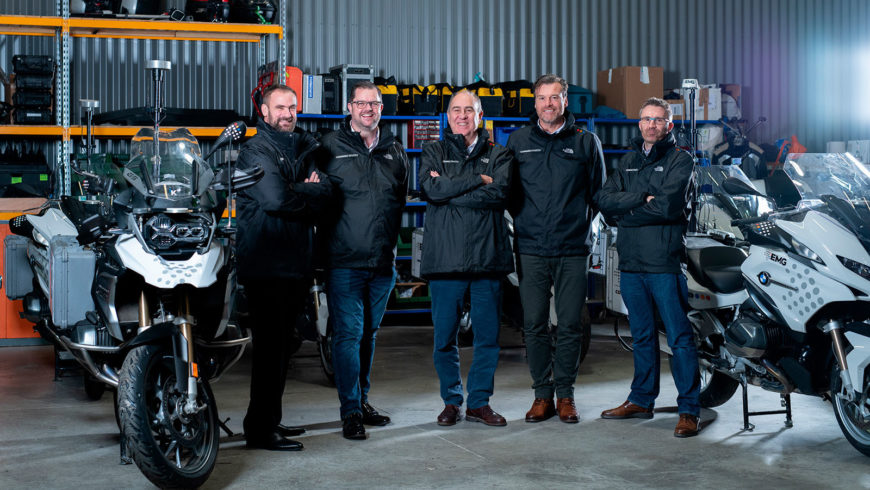
Within EMG Connectivity approx. 80 professionals are constantly working on more than 1500 events per year, with double this number on race/event days.
EMG Connectivity will be the best equipped RF company in the world providing the most extensive range of wireless broadcast solutions in the best possible quality. Among these are:
- 10 operational RF vehicles
- 300+ RF links, of which 175+ are HEVC (UHD/HDR capable)
- 35 BMW motorbikes and access to multiple electric motorbikes
- 5 equipped relay airplanes, of which 4 with pressurised cabins
- The ability to deploy 25+ EASA airworthy RF helicopters
- 20+ bonded cellular 4G/5G systems
The inhouse development company Livetools is continuously developing new devices exclusively for EMG Connectivity. Apart from Livetools, EMG also deploy the world leading RF manufacturers in the industry.
Move unites leading RF and connectivity divisions under one brand led by new international management team
Europe’s leading broadcast service provider EMG today announces that the RF Services & Connectivity in the Group will be united under the EMG brand. This means that the activities of Eurolinx, Broadcast RF and the RF activities of EMG France will be consolidated within a new business unit called EMG Connectivity. The new combination will, as global market leader, continue to deliver the bespoke customer service for which EMG is renowned all over the world. More than 1500 RF events per year are covered by the EMG Connectivity specialists including the most renowned sport events and entertainment shows of the world.
For several years, the various Connectivity business units have been collaborating and working as one at many major international events such as Tour de France and Giro d’Italia, the Olympics and FIFA World Cup, the European Championships in Munich, the marathons of London, Berlin and Vienna and many entertainment shows including Love Island and the BAFTAs. Clients working with EMG Connectivity will now be able to draw on the unrivalled knowledge and resources of the whole Group to integrate world leading solutions in remote production, IP technology, RF, satellite and 5G into their next production.
The new business unit will be led by an international team of EMG experts helmed by Bruno Gallais (Managing Director EMG Connectivity) who will hold this role alongside his work as CEO of EMG France. Gallais will be joined in the management team by Mark Houghton who will lead the UK business and will be Innovation Director for EMG Connectivity. Bruno Coudyzer from Belgium will be responsible for Business Development. From France, Rudy Dendleux will be the Technical Director while Chris Brandrick, known from Broadcast RF, will become the unit’s Commercial Director.
Within EMG Connectivity approx. 80 professionals are constantly working on more than 1500 events per year, with double this number on race/event days.
EMG Connectivity will be the best equipped RF company in the world providing the most extensive range of wireless broadcast solutions in the best possible quality. Among these are:
- 10 operational RF vehicles
- 300+ RF links, of which 175+ are HEVC (UHD/HDR capable)
- 35 BMW motorbikes and access to multiple electric motorbikes
- 5 equipped relay airplanes, of which 4 with pressurised cabins
- The ability to deploy 25+ EASA airworthy RF helicopters
- 20+ bonded cellular 4G/5G systems
The inhouse development company Livetools is continuously developing new devices exclusively for EMG Connectivity. Apart from Livetools, EMG also deploy the world leading RF manufacturers in the industry.
Facilitair bedrijf EMG heeft bekend gemaakt dat alle zogenaamde RF-diensten in de EMG Groep worden verenigd onder de noemer EMG Connectivity.
Dit betekent dat de draadloze broadcast activiteiten van Eurolinx (Benelux), Broadcast RF (VK) alsmede die van EMG Frankrijk worden samengevoegd en allen onder de EMG vlag zullen gaan opereren. Denk hierbij aan de bekende live uitzendingen met motoren en helicopters (zoals wielerkoersen en marathons) maar ook de inzet van draadloze camera’s bij sport en entertainment programma’s. Ruim 80 specialisten van EMG Connectivity werken met hun kennis en oplossingen mee aan meer dan 1500 evenementen per jaar verspreid over de hele wereld. Waaronder grootschalige evenementen zoals de Ronde van Vlaanderen, Tour de France en Giro d’Italia, de Olympische Spelen, FIFA World Cup, Tomorrowland, NAVO- en Europese topconferenties en de Marathons van Amsterdam, Rotterdam, Londen en Berlijn.
EMG Connectivity is wereldwijd marktleider en het best uitgeruste ‘RF bedrijf’ ter wereld met het meest uitgebreide assortiment draadloze oplossingen in de best mogelijke kwaliteit:
- 10 operationale RF voertuigen
- 300+ RF links waarvan 175+ HEVC (UHD/HDR geschikt)
- 35 speciale BMW motoren en toegang tot elektrische motoren
- 5 relaisvliegtuigen, waarvan 4 met een ‘pressurised’ cabine
- De inzet van 25+ EASA luchtwaardige RF helikopters
- Tientallen ‘bonded cellular’ 4G/5G zenders
Facilitair bedrijf EMG heeft bekend gemaakt dat alle zogenaamde RF-diensten in de EMG Groep worden verenigd onder de noemer EMG Connectivity.
Dit betekent dat de draadloze broadcast activiteiten van Eurolinx (Benelux), Broadcast RF (VK) alsmede die van EMG Frankrijk worden samengevoegd en allen onder de EMG vlag zullen gaan opereren. Denk hierbij aan de bekende live uitzendingen met motoren en helicopters (zoals wielerkoersen en marathons). Maar ook de inzet van draadloze camera’s bij sport en entertainment programma’s. Ruim 80 specialisten van EMG Connectivity werken met hun kennis en oplossingen mee aan meer dan 1500 evenementen per jaar verspreid over de hele wereld. Waaronder grootschalige sportevenementen zoals Tour de France en Giro d’Italia, de Olympische Spelen, FIFA World Cup, de marathons van Amsterdam, Rotterdam, Londen en Berlijn maar ook talloze entertainment- en actualiteitenprogramma’s als Koningsdag, Prinsjesdag en de Marinedagen.
EMG Connectivity is wereldwijd marktleider en het best uitgeruste ‘RF bedrijf’ ter wereld met het meest uitgebreide assortiment draadloze oplossingen in de best mogelijke kwaliteit:
- 10 operationale RF voertuigen
- 300+ RF links waarvan 175+ HEVC (UHD/HDR geschikt).
- 35 speciale BMW motoren en toegang tot elektrische motoren
- 5 relaisvliegtuigen, waarvan 4 met een ‘pressurised’ cabine
- De inzet van 25+ EASA luchtwaardige RF helikopters
- Tientallen ‘bonded cellular’ 4G/5G zenders
Bij EMG Nederland zullen ook de andere connectiviteitsdiensten zoals SNG en het Livecentre onder de noemer EMG Connectivity opereren.
Na een complexe tenderprocedure werd EMG door de stad München geselecteerd als exclusief technisch partner tijdens de Europese kampioenschappen in negen verschillende takken van sport.

Het was een bomvol sportschema dat tussen 11 en 21 augustus in München werd afgewerkt. De Beierse hoofdstad creëerde daarvoor samen met het Olympic Park een tijdelijk Lokaal Organisatie Comité, een verzameling van 180 vakspecialisten. Doel van dit LOC was om de evenement- en host broadcast-organisatie naast elkaar te brengen, wat kortere en efficiëntere communicatielijnen opleverde.
Nu de rebranding van alle EMG-bedrijven in Europa – in Nederland voorheen United – achter de rug is, werd in München weer eens duidelijk waartoe men gezamenlijk in staat is. EMG Duitsland, EMG België, EMG Nederland, EMG UK, Aerial Camera Systems (ACS), Broadcast RF en Eurolinx waren in totaal met een kleine driehonderd medewerkers actief en werkten nauw samen onder leiding van een centraal projectteam.

Chris Demeulemeester fungeerde als key accountmanager tijdens deze monsterklus. “Een van de belangrijkste verschillen met andere grote multi-sportevenementen was eigenlijk de organisatiestructuur; in plaats van voor een productiemaatschappij te werken zoals bijvoorbeeld bij de Olympische Spelen of de Tour de France, was onze klant hier het LOC dat speciaal voor de gelegenheid werd opgezet door het European Championships Management dat het evenement beheert en coördineert in samenwerking met de deelnemende federaties en de stad München.”

Olympiapark
EMG was belast met alle technische en productiefaciliteiten in én buiten het Olympiapark, waaronder twaalf IP remote regies, zes reportagewagens (OB trucks) op de locaties in en rond München, een mega Technical Operations Center, een Media Asset Management-systeem en alle draadloze camera en RF-voorzieningen. Het LOC was op haar beurt verantwoordelijk voor de redactie, zoals het inhuren van regisseurs en cameramensen. Voor het wielrennen en de marathon bijvoorbeeld werd een grote groep Nederlandse en Belgische EMG-collega’s ingehuurd vanwege hun expertise op het gebied van connectiviteit.
Tijdens de EK’s werden in negen verschillende sporten Europese titels verdeeld: atletiek, turnen, beachvolleybal, kanovaren, roeien, sportklimmen, tafeltennis, triatlon en wielrennen. In totaal kwamen in München meer dan 4.700 sporters uit vijftig landen in actie en werden er 177 wedstrijden gehouden. De EBU liet weten dat publieke zenders in zeker veertig Europese landen meer dan 3.500 uur live sport uitzonden op televisie – 500 uur meer dan vier jaar geleden. In Nederland zond de NOS dagelijks een aantal uren live uit via NPO 3 en via streams online en de NOS-app.
Backstage:

diPloy
Het hart van de European Championships vormde het fraaie Olympiapark met onder meer het Olympiastadion, dat werd gebouwd voor de Zomerspelen van 1972 en de hoofdlocatie was voor de atletiekonderdelen. In het Olympiapark vonden ook freestyle BMX, mountainbike, crosscountry, de triatlon en het turnen plaats.
“Alle sporten hebben we met twaalf verschillende ‘remote IP’ regies geproduceerd”, aldus Demeulemeester. “Voor de wedstrijden die niet in het Olympiapark plaatsvonden, werden zes externe OB trucks ingezet. In het International Broadcast Centre bewaakten we de kwaliteit, werden de feeds doorgestuurd naar andere regies en distribueerden we ze verder. De signaaldistributie tussen alle locaties in München werd verzorgd via Riedel MicroN technologie. Zij creëerden eigenlijk de snelwegen en wij vulden die met de nodige IP streams om flexibel content te produceren.”
“We hebben het complete event met ons IP diPloy concept geproduceerd. De gehele ‘engine power’ was ondergebracht in twee zeecontainers op de hoek van het IBC. Deze twee data centers vervingen eigenlijk de capaciteit van twaalf ‘klassieke’ regiewagens”, vertelt Demeulemeester. EMG ontwierp dit IP-platform voor de Olympische Spelen in Tokio. De grote uitdaging daar was de enorme ‘change-over’ tussen de openingsceremonie en de eerste atletiekwedstrijden. In 2021 werden tijdens de FIS Nordic World Ski Championships voor het eerst meerdere regies op kilometers afstand aan elkaar verbonden. Datzelfde concept vond zijn weg naar het Grand Slam-tennistoernooi van Roland Garros.

MAM
Volgens Demeulemeester betekende het gebruik van diPloy in München veel minder bekabeling en hoefden minder uren aan de installatie te worden besteed. “We waren aanwezig in meer dan veertig containers op het IBC met een opbouwtijd van slechts zes dagen. Technisch gezien blijft het natuurlijk enorm complex, ook al omdat de complete infrastructuur volledig redundant moet zijn.” EMG was tijdens de EK ook verantwoordelijk voor de draadloze camera-infrastructuur. Eurolinx (Nederland en België) en zusterfirma Broadcast RF uit Engeland gebruikten daarvoor exclusief zenders in de 7Ghz band.
Het meest gecompliceerde en minst zichtbare aspect van EMG’s rol bij deze operatie was volgens Demeulemeester het tijdelijk opgezette Media Asset Management-platform (MAM). Dit netwerk verbond alle OB trucks en IP regies. In totaal stonden 54 x EVS VIA-servers in netwerk met elkaar. “Dit MAM-systeem was een online website met ingebouwde zoekfunctionaliteit. Alle clips van alle sporten waren cloudbased beschikbaar voor sportfederaties, rechtenhouders, journalisten en tv-stations zodat ze konden worden gebruikt voor dagelijkse journaals, social media, archieven en dergelijke, in alle mogelijke formats en codecs.”
“Alle feeds werden ingeladen in dit MAM-systeem, dat vervolgens weer in verbinding stond met de acht montagesets die we ter plekke hadden gebouwd. De slomo servers (LSM, tevens EVS) van alle regies stonden in een centraal, uiteraard sterk beveiligd EMG netwerk. Op die manier verbonden we het centrale International Broadcast Center op het Olympiapark met alle sporten die buiten het park plaatsvonden. Een team van tien loggers voegde de nodige metadata toe, zodat clips van alle live events gemakkelijk konden worden teruggevonden. In totaal hadden we ongeveer 912 terabyte aan lokale opslag alleen al om de operatie te laten draaien. Na de EK’s zijn we nog 48 uur gebleven om de content naar elders te uploaden en er een deep archive van te maken.”
RCS Sport contracteert EMG als facilitaire partij voor al haar Italiaanse wielerwedstrijden
Boedapest – 5 mei 2022 – Broadcast service provider EMG kondigde vandaag, tijdens de ‘Grande Partenza’ van de 105e Giro d’Italia in de Hongaarse hoofdstad Boedapest, een driejarig partnership aan voor de technische productie van negen wielerwedstrijden georganiseerd door RCS Sport in Italië, waaronder de Giro d’Italia, Tirreno-Adriatico, Strade Bianche en de ‘wielermonumenten’ Milaan-San Remo en De Ronde van Lombardije.
EMG is sinds vele jaren dé specialist voor het in beeld brengen en uitzenden van internationale wielerevenementen zoals de Ronde van Frankrijk, de Ronde van Vlaanderen, de Amstel Gold Race en talloze andere koersen over de hele wereld. Voor de samenwerking met RCS Sport heeft EMG met een internationaal team van specialisten uit België, Frankrijk, Italië én Nederland een werkwijze ontwikkeld die in hoge kwaliteit live tv-verslaggeving garandeert voor tientallen zenders van de mooiste en meest uitdagende Italiaanse koersen.
Voor de wedstrijden die RCS Sport in Italië organiseert, worden door EMG gemiddeld drie reportagewagens, 10 motoren, 10 camera’s langs het wielerparcours (inclusief superslomo en RF) en twee helikopters met gyro-gestabiliseerde Cineflex-camera’s ingezet. De livebeelden worden, ongeacht de weersomstandigheden, gegarandeerd door twee verbindingsvliegtuigen. EMG zal aanwezig zijn met een internationale crew van 120 professionals in de hele productieketen – van bekabeling tot helicoptershots en van live regie tot highlights editing.
Paolo Bellino, CEO van RCS Sport: “Dit is echt een keerpunt voor ons aangezien we voor het eerst in de geschiedenis van de Giro d’Italia hebben besloten om zelf de TV-productie in handen te nemen. Maar wel met een grote internationale partner als EMG Group waar we tijdens de voorjaarsklassiekers uitgebreid mee getest hebben. Het is nu het moment om deze belangrijke stap te zetten, een natuurlijke ontwikkeling bij de organisatie van grote sportevenementen zoals de Giro d’Italia. We zullen elke etappe volledig live aanbieden aan de zenders, zodat wielerfans over de hele wereld elk moment van de zwaarste wedstrijd op de mooiste plek ter wereld zullen kunnen volgen”.
“Deze internationale samenwerking binnen EMG is echt geweldig”, zegt René Delwel, CEO van EMG Nederland: “Maar ik denk graag dat dit nog maar het begin is. We werken als EMG binnen Europa steeds meer samen, zowel bij de grote internationale sportproducties als Roland Garros komende maand als bij reality programma’s als Love Island die we over de hele wereld opnemen. De specifieke knowhow van onze Nederlandse televisiemakers gaat zo de hele wereld over.”
