*English version below
De slimste weg van data naar graphics
In onze voetbalverslaggeving gaan we de Amerikanen achterna: steeds vaker krijgen we cijfers en statistieken te zien over zaken als balbezit, balveroveringen, passnauwkeurigheid of schoten op doel. Om de workflow van data naar graphics te ondersteunen, hebben ze bij Boost Graphics een nieuw platform: Next Editorial. ‘We laten AI zelfs al meedenken, dat levert mooie suggesties op.’
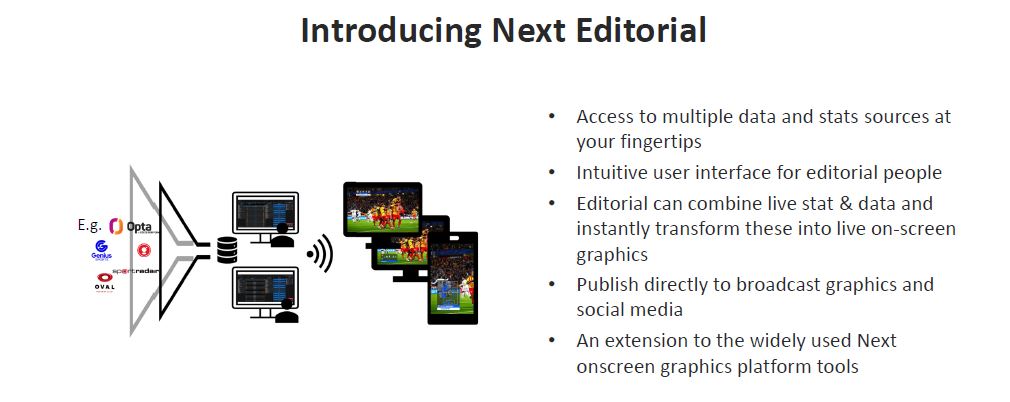
De kleur van de veters zal nog net niet worden vastgelegd, maar verder ontsnapt weinig aan de dataverzameling rond sportwedstrijden. Van elke speler kunnen eindeloze statistieken worden overlegd, van speelminuten tot voltooide passes, afgelegde afstand en heatmaps voor balcontacten. En dan hebben we het alleen nog over voetbal, maar vrijwel elke sportbond heeft contracten met zogenaamde ‘statproviders’, die alle mogelijke gegevens over wedstrijden, teams en spelers vastleggen en gegroepeerd kunnen uitserveren. Dat gebeurt alleen niet altijd even overzichtelijk, vertelt Jeroen van Rossum, director of operations bij Boost International. “De data die we in graphics op het scherm willen tonen, worden aangeleverd in verschillende formats. In de huidige werkwijze werkt de redacteur samen met de graphics operator om te bepalen welke data interessant zijn. Dan maakt de operator van die data een graphic en zet deze vervolgens live. Met Next Editorial heeft de redacteur niet alleen een tool beschikbaar die inzicht geeft in de beschikbare live data, hij kan die vervolgens ook zelf in een graphic template zetten als preview, die hij kiesbaar kan maken voor de operator. De benodigde graphics zijn er dus een stuk sneller, dat scheelt nogal tijdens een live-uitzending met de nodige tijdsdruk. Daarnaast hebben we een AI-functionaliteit toegevoegd die inhoudelijk suggesties kan doen op basis van de beschikbare live data.”
Betere storytelling
Die nieuwe functionaliteit kijkt mee in de data die wordt verstrekt door de statistiekleverancier. Omdat deze AI-tool de data leest en de context kent, kan de redacteur ’m gebruiken als een soort Copilot. Van Rossum: “Kijk, zegt het systeem, deze cijfers kunnen voor jou relevant zijn. Het is een recommendation engine. Het voordeel voor de redacteur is dat die in meerdere live databronnen kan zoeken om combinaties te maken tussen twee teams, om maar wat te noemen, of om juist heel specifieke info van één speler weer te geven. Hij heeft dat allemaal in een overzichtelijke interface beschikbaar, waarmee hij de graphic meteen kan voorbereiden. Dan ziet hij ook hoe het eruit komt te zien op het scherm.” Het voordeel gaat verder dan enkel tijdwinst. Doordat de redacteur de gesuggereerde of zelf voorbereide graphics snel in een vorm kan gieten, kan de operator zich volledig focussen op de wedstrijd. Van Rossum: “Als er extra info te geven is, dan komt de redacteur daar mee. Zo maak je samen het inhoudelijke verhaal, je hebt daar meer tijd voor. En zo krijg je betere storytelling. Next Editorial is een tool die de inhoudelijke mensen rondom een sportwedstrijd niet alleen ondersteunt en meer inzicht geeft, maar ook de snelheid van het live zetten van data in de vorm van graphics enorm verhoogt.”
AI als ondersteuning
Next Editorial is halverwege het vorige voetbalseizoen voor het eerst ingezet in Frankrijk en wordt sinds dit seizoen standaard bij iedere competitiewedstrijd in Ligue 1 gebruikt. De eerste ervaringen met het systeem zijn erg positief, ook de AI-tool werd in de eerste testfase goed ontvangen. De functie is beschikbaar binnen het platform, maar zal in de verschillende landen gefaseerd worden geïntroduceerd. “De redacteuren moeten ermee leren werken. Ze gaan hopelijk ervaren dat het fijn werkt als je slimme suggesties krijgt. Dat mag iedereen in zijn eigen tempo doen, maar ik verwacht dat ze dit snel zullen omarmen. We zetten AI in als ondersteuning, daar zit de meerwaarde ervan.”
ENGLISH VERSION BELOW
Boost Graphics’ new platform: Next Editorial
The smartest route from data to graphics
In football coverage, we are following the American lead; we are seeing more and more numbers and statistics on things like possession, ball recoveries, pass accuracy and shots on target. To support the workflow from data to graphics, Boost Graphics has launched a new platform, Next Editorial. The platform even lets AI think along, yielding smart suggestions.
They may not log lace colour just yet, but very little escapes data collection around sports matches. For every player there are endless statistics, from minutes played to completed passes, distance covered and heat maps for touches. And that is only football. Virtually every sports federation has contracts with stat providers, who record data about matches, teams and players and deliver it in grouped formats. That does not always arrive in an equally clear way, says Jeroen van Rossum, director of operations at Boost International. “The data we want to show as on-screen graphics is supplied in different formats. In the current workflow the editor works with the graphics operator to decide which data is interesting. The operator then turns that data into a graphic and puts it live. With Next Editorial the editor not only has a tool that gives insight into the available live data, but they can also place that data directly into a graphic template as a preview, which they can make selectable for the operator. The required graphics are produced much faster, which makes a big difference during a live broadcast with time pressure. On top of that we have added an AI feature that can make content suggestions based on the available live data.”
Better storytelling
The new feature analyses data from the stats providers. Because this AI tool reads the data and knows the context, the editor can use it like a copilot. Van Rossum adds, “In effect, the system highlights which numbers may be relevant — it acts as a recommendation engine. The advantage for the editor is that they can search across multiple live data sources to make combinations between two teams, for example, or to display very specific information about a single player. All of this is available within a clear interface, where the editor also sees how it will look on screen and can prepare the graphic immediately.”
The benefit goes beyond saving time. Because the editor can quickly shape the suggested or self-prepared graphics, the operator can focus fully on the match. “If there is extra information to add, the editor brings it in,” says Van Rossum. “That way you build the story together and have more time to focus on the content, which ultimately leads to better storytelling. Next Editorial not only supports the editorial team during a live sports match and gives them greater insight, it also greatly increases the speed at which live data can be taken on air as graphics.”
AI as support
Next Editorial was first deployed halfway through last football season in France and has been used by default for every league match in Ligue 1 since this season. The first experiences with the system were very positive, and the AI tool was also well received in the initial test phase. The feature is available within the platform and will be rolled out in phases across different countries. Van Rossum concludes, “Editors need to learn how to work with it, and everyone can adopt it at their own pace, but I expect they will embrace it quickly. We use AI as support; that is where its value lies.”
*English version below
Gravity Media zet een volgende stap in de integratie van haar activiteiten in Nederland en België. Met het vertrek van Kathleen Wellink per 1 maart als directeur Outside Broadcast & Studio’s wordt de operationele aansturing in de Benelux herijkt. “Klanten willen niet bij al die winkeltjes apart gaan shoppen.”
Koen Bredael, sinds zes jaar operationeel directeur van Gravity Media België en al sinds 1995 werkzaam bij het Vlaamse Videohouse, krijgt de rol van operationeel directeur over beide landen. De Antwerpenaar, die evenals zijn Belgische collega Bart De Maeyer, de Regional CEO van Gravity Media Europe, meerdere dagen per week in Hilversum neerstrijkt, wordt ondersteund door Gijs Vos, die als manager operations een uitgebreidere verantwoordelijkheid heeft binnen de Nederlandse organisatie.
De wijziging past binnen een bredere strategische beweging om de samenwerking tussen België en Nederland structureel te verdiepen. “Onze klanten organiseren zich steeds vaker Benelux-breed. Productiehuizen kijken niet meer per land, maar zoeken schaalvoordelen en synergie,” zegt Bredael. “Daar moet onze organisatie op aansluiten. Kathleen heeft hierin al goede stappen gezet op logistiek vlak. Echter kunnen we dit op meerdere vlakken nog verder optimaliseren. Daar gaan we nu echt tempo in maken.”
Media Services
Concreet betekent dit dat verschillende disciplines – meercamera, connectivity, ENG en Blue Label – onder één overkoepelende structuur worden samengebracht: Media Services. Die opzet sluit aan bij de veranderende vraag vanuit de markt. Grote producties bestaan steeds vaker uit een combinatie van meerdere diensten, waarbij klanten behoefte hebben aan centrale coördinatie en één aanspreekpunt. “Producenten willen geen ‘losse eilandjes’ meer,” aldus Bredael. “Ze zoeken oplossingen, geen afzonderlijke services. Door alles onder één koepel te brengen, kunnen we die rol beter invullen en de klant ontzorgen.”
Dezelfde structuur wordt zowel in Nederland als België doorgevoerd. Lokale productie blijft daarbij leidend; de integratie is primair organisatorisch en procesmatig van aard. Het gaat namelijk om het slimmer organiseren van kennis, innovatie en ondersteuning.” Binnen de nieuwe constellatie richt Gijs Vos zich op de backoffice en projectorganisatie. Alle projecten worden vanuit één centraal projectbureau aangestuurd, met gezamenlijke crewplanning en nauwere samenwerking tussen afdelingen. De operationele uitvoering en de aansturing van mensen en middelen vallen onder Koen Bredael. “Door de projectbureaus fysiek en organisatorisch samen te brengen, creëren we meer efficiëntie en betere afstemming tussen disciplines,” zegt Gijs Vos. “Dat is een duidelijke verandering ten opzichte van de eerdere, meer gescheiden werkwijze.”
Internationale ervaring als versneller
Gravity Media werkt al jaren intensief samen binnen de internationale groep, onder meer bij grote evenementen zoals dit jaar de Olympische Spelen, het WK voetbal en Roland Garros. ‘’Die ervaring wordt nu explicieter benut voor de Benelux-markt zegt Vos.’’ Ook producties als Love Island worden al ‘grensoverschrijdend’ uitgevoerd. “Wat we internationaal hebben geleerd over schaal, remote productie en samenwerking, zetten we lokaal in,” aldus Bredael. “Dat is een duidelijke meerwaarde voor onze klanten.”
Twee domeinen zijn expliciet nu al Benelux-breed georganiseerd: innovatie en Livecentre (MCR). Voor dat laatste wordt één gezamenlijke aansturing ingericht, met Jasper Jurgens als verantwoordelijke voor zowel Nederland als België. Beide landen zijn al via vaste glasvezelverbindingen aan elkaar gekoppeld en werken met main- en backup-structuren over de grens. Ook innovatie wordt centraal aangestuurd. Nieuwe technologieën, waaronder software-based en remote productiemodellen, worden niet langer per land ontwikkeld, maar gedeeld binnen de Benelux en daarbuiten. Projecten als het World Economic Forum in Davos, dat volledig remote en software-based wordt geproduceerd, illustreren die aanpak.
Markt onder druk
Deze herstructurering bij Gravity Media Nederland en België vindt plaats tegen de achtergrond van toenemende financiële ‘uitdagingen’ zoals dat eufemistisch heet. “Die zijn in beide landen vergelijkbaar,” zegt Bredael. “Budgetten staan onder druk en tegelijkertijd versnelt de technologische ontwikkeling.” AI speelt daarin een groeiende rol, met name in postproductie en content operations, zoals ondertiteling en metadata. In andere delen van het productieproces wordt nog vooral onderzocht waar daadwerkelijk efficiency te behalen valt. “Niet alles wat als AI wordt gepresenteerd, is dat ook. We maken daarin bewuste keuzes.” Met de nieuwe Benelux-structuur positioneert Gravity Media zich nadrukkelijk als geïntegreerde mediaservicepartner, voorbereid op verdere schaalvergroting, technologische versnelling en internationale samenwerking.
TEKST: Jeroen te Nuijl // Fotografie: Studio Kastermans
ENGLISH VERSION BELOW
Gravity Media strengthens Benelux structure with integrated Media Services
Gravity Media is taking the next step in the integration of its activities in the Netherlands and Belgium. With the departure of Kathleen Wellink as Director of Outside Broadcast & Studios on 1 March, operational management in the Benelux will be reassessed. “Customers don’t want to shop at all those different shops separately.”
Koen Bredael, who has been Operational Director of Gravity Media Belgium for six years and has worked at the Flemish Videohouse since 1995, will take on the role of Operational Director for both countries. The Antwerp native, who, like his Belgian colleague Bart De Maeyer, Regional CEO of Gravity Media Europe, spends several days a week in Hilversum, will be supported by Gijs Vos. Vos, as operations manager, has broader responsibilities within the Dutch organisation.
The change is part of a broader strategic move to deepen cooperation between Belgium and the Netherlands. “Our customers are increasingly organising themselves across the Benelux. Production companies no longer look at each country individually, but instead seek economies of scale and synergy,” says Bredael. “Our organisation must respond to this. Kathleen has already taken positive steps in this regard, particularly in logistics. However, we can further optimise this in several areas. We are now going to really pick up the pace in this regard.”
Media Services
In concrete terms, this means that various disciplines – multi-camera, connectivity, ENG and Blue Label – will be brought together under one umbrella structure: Media Services. This structure reflects changing market demand. Large productions increasingly consist of a combination of multiple services, with customers requiring central coordination and a single point of contact.
“Producers no longer want ‘separate islands’,” says Bredael. “They are looking for solutions, not separate services. By bringing everything under one umbrella, we can better fulfil that role and take care of everything for the customer.”
The same structure is being implemented in both the Netherlands and Belgium. Local production remains central; the integration is primarily organisational and process-related. It is about organising knowledge, innovation and support in a smarter way.”
Within the new constellation, Gijs Vos focuses on the back office and project organisation. All projects will be managed from a single, central project office, with joint crew planning and closer cooperation between departments. Koen Bredael is responsible for operational implementation and the management of people and resources.
“By bringing the project offices together physically and organisationally, we are creating greater efficiency and better coordination between disciplines,” says Gijs Vos. “This represents a clear change from the previous, more separate way of working.”
International experience as an accelerator
Gravity Media has been working intensively within the international group for years, including at major events such as this year’s Olympic Games, the World Cup and Roland Garros. That experience is now being used more explicitly for the Benelux market, says Vos.
Productions such as Love Island are also already being carried out ‘across borders’. “We are applying what we have learned internationally about scale, remote production and collaboration locally,” says Bredael. “That is a clear added value for our customers.”
Two areas are already explicitly organised across the Benelux: innovation and Livecentre (MCR). For the latter, a single joint management structure is being set up, with Livecentre Project Manager Jasper Jurgens responsible for both the Netherlands and Belgium. Both countries are already linked by fixed fibre optic connections and work with main and backup structures across the border. Innovation is also managed centrally across Benelux. New technologies, including software-based and remote production models, are no longer developed per country but shared across Benelux and beyond. Projects such as the World Economic Forum in Davos, which is produced entirely remotely, illustrate this approach.
Market under pressure
This restructuring at Gravity Media Netherlands and Belgium is taking place against a backdrop of increasing financial ‘challenges’, as they are euphemistically called. “These are similar in both countries,” says Bredael. “Budgets are under pressure and at the same time technological development is accelerating.”
AI is playing a growing role in this, particularly in post-production and content operations, such as subtitling and metadata. In other parts of the production process, research is still being conducted into where efficiency can actually be achieved. “Not everythingpresented as AI is actually AI. We make conscious choices in this regard,” Bredael adds.
With the new Benelux structure, Gravity Media is positioning itself as an integrated media service partner, prepared for further scaling, technological acceleration and international collaboration.
FACILITIES
TEXT: Jeroen te Nuijl // Photography: Studio Kastermans
*English version below
AI & Innovatie bij Gravity Media
Slimmer en efficiënter werken, sneller produceren en meer ruimte voor creativiteit; dat is de belofte van AI. Maar de toekomst van media wordt niet alleen bepaald door veranderende technologie, ook door de mensen die ermee werken. Daarom krijgt kunstmatige intelligentie binnen Gravity Media steeds meer vorm, in de producties, maar vooral onder collega’s. Innovatie is voor Gravity Media geen afdeling, maar een houding. “Bedenken wat we nóg beter, efficiënter, slimmer of sneller kunnen, daar krijgen wij energie van.”
AI is allang geen ver-van-je-bedshow meer voor Gravity Media. Al jaren wordt er geëxperimenteerd met toepassingen die het werk efficiënter en kwalitatief beter maken. Dat begon jaren geleden al met speech-to-text: het automatisch omzetten van spraak in tekst, zodat redacties sneller materiaal kunnen doorzoeken. “Toen was de techniek nog pril,” vertelt product- en innovatiemanager Cafer Poslu, “maar inmiddels is de nauwkeurigheid zo goed dat we de data direct kunnen gebruiken in de montage. Daardoor kunnen editors bijvoorbeeld binnen enkele seconden alle fragmenten terugvinden waarin iemand over ‘blauwe schoenen’ praat. Dat scheelt enorm veel tijd.” AI speelt een sleutelrol in de toekomstvisie van Gravity Media. Cafer: “We zijn een facilitaire partij. Dat betekent dat klanten bij ons terechtkomen als ze expertise nodig hebben. Dan is het belangrijk dat wij weten wat er mogelijk is in de markt en hoe we dat kunnen toepassen. Niet alleen voor onszelf, maar juist voor onze klanten.”
Maatwerk
Om AI optimaal in de workflows te integreren kiest Gravity Media er bewust de toepassing in nauwe samenwerking met klanten vorm te geven. “We onderzoeken welke tools en technologieën het meest relevant en effectief zijn en hoe ze écht kunnen bijdragen aan het productieproces. Zo krijgen klanten niet alleen inzicht in wat er mogelijk is, maar ook in welke impact bepaalde toepassingen hebben op hun eigen workflow. Vanuit onze adviserende rol zetten we onze kennis en ervaring in om geschikte oplossingen te selecteren, testen en vertalen naar praktische tools die aantoonbare meerwaarde bieden, in efficiëntie, kwaliteit én tijdswinst.”
Mensenwerk
Technologie optimaliseert dus de processen, waardoor er meer tijd overblijft voor het creatieve vakmanschap. “AI mag nooit het menselijke vervangen,” benadrukt Cafer. “Het moet ons ondersteunen. Wij willen dat creatieven juist meer ruimte krijgen voor wat ze het liefst doen: maken. Als AI helpt om onze repeterende taken – het zogenaamde ‘monnikenwerk’ – uit handen te nemen, kunnen mensen zich richten op het creatieve proces. Dat is waar de kwaliteit vandaan komt.” Om AI breder te verankeren in de organisatie, worden collega’s gestimuleerd om te leren, experimenteren en hun kennis te delen. In summer schools konden ze laagdrempelig kennismaken met AI. Cafer: “Wat kan het, hoe gebruik je het, hoe prompt je goed? Want dat is een vak op zich: leren hoe je een AI-systeem aanstuurt om het juiste resultaat te krijgen. Die trainingen werken; mensen worden nieuwsgierig en gaan zelf ontdekken wat het voor hun werk kan betekenen.”
Changemakers
Cafer merkt dat AI voor velen nog een vaag gegeven kan zijn. “Je weet dat het er is, maar nog niet wat er allemaal mogelijk is en hoe je het moet toepassen. Daardoor blijft het een complex en ongrijpbaar iets.” Om het voor collega’s concreet te maken neemt Gravity Media deel aan het Changemakers-programma. Cafer: “Dat gaat verder dan alleen begrijpen wat AI is en hoe we het kunnen inzetten, het gaat ook om collega’s activeren. Hoe brengen we AI naar de voorgrond?” Negen maanden lang volgen deelnemers uit verschillende mediabedrijven een traject waarin AI, design thinking en persoonlijk leiderschap samenkomen. Bryan Boor, hoofd van de vakgroep Live Graphics, is een van de deelnemers: “Changemakers is een programma waarin je zoveel mogelijk bagage krijgt om uiteindelijk verandering teweeg te brengen in je eigen organisatie,” vertelt hij. “Je leert theoretisch wat AI is en hoe je het kunt inzetten om jouw problematiek op te lossen. Maar je werkt ook aan jezelf. Hoe presenteer je een idee, hoe overtuig je anderen, hoe neem je mensen mee in verandering? Dat maakt het programma zo sterk. We hoeven niet in negen maanden een product te lanceren. We moeten vooral een beweging starten. Dat AI iets normaals wordt binnen onze organisatie. Dat collega’s niet denken: ‘Dat is niets voor mij’, maar juist: ‘Wat kan ik ermee?’”
Dat past bij hoe Gravity Media innovatie ziet: als iets wat begint bij mensen. Cafer: “We kunnen de slimste tools hebben, maar zonder draagvlak gebeurt er niets. Daarom is het Changemakers-programma zo waardevol. Door kennis te delen, gaan we sneller vooruit. We willen met AI onze processen verbeteren en nieuwe diensten ontwikkelen, maar altijd op een manier die past bij wie we zijn: menselijk, betrokken en professioneel.”
ENGLISH VERSION BELOW
AI and innovation at Gravity Media
Work smarter, more efficient, produce faster, create more room for creativity. That is the promise of AI. But the future of media is shaped not only by changing technology, it is shaped by the people who use it. That is why artificial intelligence is taking on a bigger role within Gravity Media, in productions and especially among colleagues. For Gravity Media, innovation is not a department, it is a mindset. “Thinking about what we can do even better, more efficient, smarter or faster, that is what energises us.”
AI has long since stopped being something distant for Gravity Media. For years we have been experimenting with applications that make the work more efficient and improve quality. This started years ago with speech to text, the automatic conversion of speech to text so that editorial teams can search material more quickly. “The technology was still in its infancy back then,” says product and innovation manager Cafer Poslu, “but the accuracy is now so good that we can use the data directly in the edit. That allows editors to find within seconds all the clips in which someone talks about blue shoes. It saves a huge amount of time.”
AI plays a key role in Gravity Media’s vision for the future. Cafer: “We are a facilities partner. That means clients come to us when they need expertise. It is important that we know what is possible in the market and how we can apply it. Not only for ourselves, but above all for our clients.”
Tailor made
To integrate AI optimally into workflows, Gravity Media deliberately shapes each application in close collaboration with clients. “We research which tools and technologies are most relevant and effective and how they can truly contribute to the production process. That way clients gain insight into what is possible and into the impact that certain applications have on their own workflow. From our advisory role we use our knowledge and experience to select and test suitable solutions and translate them into practical tools that deliver proven added value in efficiency, quality and time savings.”
People first
Technology optimises processes, which leaves more time for creative craftsmanship. “AI should never replace the human element,” Cafer emphasizes. “It should support us. We want creatives to have more room for what they love to do most, to make. If AI helps to take repetitive tasks off our hands, the so called monk’s work, people can focus on the creative process. That is where quality comes from.”
To anchor AI more broadly in the organisation, colleagues are encouraged to learn, experiment and share knowledge. During summer schools they could get to know AI in an accessible way. Cafer: “What can it do, how do you use it, how do you prompt well. That is a discipline in its own right, learning how to steer an AI system to get the right result. These trainings work. People become curious and start discovering for themselves what it can mean for their work.”
Changemakers
Cafer notices that AI can still feel vague for many. “You know it is there, but not yet what is possible and how to apply it. That keeps it complex and elusive.” To make it concrete for colleagues, Gravity Media is taking part in the Changemakers program. Cafer: “It goes beyond understanding what AI is and how we can use it. It is also about activating colleagues. How do we bring AI to the foreground.”
For nine months, participants from different media companies follow a track in which AI, design thinking and personal leadership come together. Bryan Boor, head of the Live Graphics discipline, is one of the participants. “Changemakers is a program that gives you as much baggage as possible to ultimately bring about change in your own organisation,” he says. “You learn in theory what AI is and how you can deploy it to solve your challenges. You also work on yourself. How do you present an idea, how do you persuade others, how do you bring people along in change. That is what makes the program so strong. We do not have to launch a product in nine months. We mainly need to start a movement. That AI becomes something normal within our organization. That colleagues do not think, that is not for me, but rather, what can I do with it.”
That fits the way Gravity Media views innovation, as something that starts with people. Cafer: “We can have the smartest tools, but without support nothing happens. That is why the Changemakers program is so valuable. By sharing knowledge, we move forward faster. We want to improve our processes with AI and develop new services, but always in a way that matches who we are, human, engaged and professional.”
*English version below
De slimste weg van data naar graphics
In onze voetbalverslaggeving gaan we de Amerikanen achterna: steeds vaker krijgen we cijfers en statistieken te zien over zaken als balbezit, balveroveringen, passnauwkeurigheid of schoten op doel. Om de workflow van data naar graphics te ondersteunen, hebben ze bij Boost Graphics een nieuw platform: Next Editorial. ‘We laten AI zelfs al meedenken, dat levert mooie suggesties op.’
De kleur van de veters zal nog net niet worden vastgelegd, maar verder ontsnapt weinig aan de dataverzameling rond sportwedstrijden. Van elke speler kunnen eindeloze statistieken worden overlegd, van speelminuten tot voltooide passes, afgelegde afstand en heatmaps voor balcontacten. En dan hebben we het alleen nog over voetbal, maar vrijwel elke sportbond heeft contracten met zogenaamde ‘statproviders’, die alle mogelijke gegevens over wedstrijden, teams en spelers vastleggen en gegroepeerd kunnen uitserveren. Dat gebeurt alleen niet altijd even overzichtelijk, vertelt Jeroen van Rossum, director of operations bij Boost International. “De data die we in graphics op het scherm willen tonen, worden aangeleverd in verschillende formats. In de huidige werkwijze werkt de redacteur samen met de graphics operator om te bepalen welke data interessant zijn. Dan maakt de operator van die data een graphic en zet deze vervolgens live. Met Next Editorial heeft de redacteur niet alleen een tool beschikbaar die inzicht geeft in de beschikbare live data, hij kan die vervolgens ook zelf in een graphic template zetten als preview, die hij kiesbaar kan maken voor de operator. De benodigde graphics zijn er dus een stuk sneller, dat scheelt nogal tijdens een live-uitzending met de nodige tijdsdruk. Daarnaast hebben we een AI-functionaliteit toegevoegd die inhoudelijk suggesties kan doen op basis van de beschikbare live data.”
Betere storytelling
Die nieuwe functionaliteit kijkt mee in de data die wordt verstrekt door de statistiekleverancier. Omdat deze AI-tool de data leest en de context kent, kan de redacteur ’m gebruiken als een soort Copilot. Van Rossum: “Kijk, zegt het systeem, deze cijfers kunnen voor jou relevant zijn. Het is een recommendation engine. Het voordeel voor de redacteur is dat die in meerdere live databronnen kan zoeken om combinaties te maken tussen twee teams, om maar wat te noemen, of om juist heel specifieke info van één speler weer te geven. Hij heeft dat allemaal in een overzichtelijke interface beschikbaar, waarmee hij de graphic meteen kan voorbereiden. Dan ziet hij ook hoe het eruit komt te zien op het scherm.” Het voordeel gaat verder dan enkel tijdwinst. Doordat de redacteur de gesuggereerde of zelf voorbereide graphics snel in een vorm kan gieten, kan de operator zich volledig focussen op de wedstrijd. Van Rossum: “Als er extra info te geven is, dan komt de redacteur daar mee. Zo maak je samen het inhoudelijke verhaal, je hebt daar meer tijd voor. En zo krijg je betere storytelling. Next Editorial is een tool die de inhoudelijke mensen rondom een sportwedstrijd niet alleen ondersteunt en meer inzicht geeft, maar ook de snelheid van het live zetten van data in de vorm van graphics enorm verhoogt.”

AI als ondersteuning
Next Editorial is halverwege het vorige voetbalseizoen voor het eerst ingezet in Frankrijk en wordt sinds dit seizoen standaard bij iedere competitiewedstrijd in Ligue 1 gebruikt. De eerste ervaringen met het systeem zijn erg positief, ook de AI-tool werd in de eerste testfase goed ontvangen. De functie is beschikbaar binnen het platform, maar zal in de verschillende landen gefaseerd worden geïntroduceerd. “De redacteuren moeten ermee leren werken. Ze gaan hopelijk ervaren dat het fijn werkt als je slimme suggesties krijgt. Dat mag iedereen in zijn eigen tempo doen, maar ik verwacht dat ze dit snel zullen omarmen. We zetten AI in als ondersteuning, daar zit de meerwaarde ervan.”
ENGLISH VERSION BELOW
Boost Graphics’ new platform: Next Editorial
The smartest route from data to graphics
In football coverage, we are following the American lead; we are seeing more and more numbers and statistics on things like possession, ball recoveries, pass accuracy and shots on target. To support the workflow from data to graphics, Boost Graphics has launched a new platform, Next Editorial. The platform even lets AI think along, yielding smart suggestions.
They may not log lace colour just yet, but very little escapes data collection around sports matches. For every player there are endless statistics, from minutes played to completed passes, distance covered and heat maps for touches. And that is only football. Virtually every sports federation has contracts with stat providers, who record data about matches, teams and players and deliver it in grouped formats. That does not always arrive in an equally clear way, says Jeroen van Rossum, director of operations at Boost International. “The data we want to show as on-screen graphics is supplied in different formats. In the current workflow the editor works with the graphics operator to decide which data is interesting. The operator then turns that data into a graphic and puts it live. With Next Editorial the editor not only has a tool that gives insight into the available live data, but they can also place that data directly into a graphic template as a preview, which they can make selectable for the operator. The required graphics are produced much faster, which makes a big difference during a live broadcast with time pressure. On top of that we have added an AI feature that can make content suggestions based on the available live data.”
Better storytelling
The new feature analyses data from the stats providers. Because this AI tool reads the data and knows the context, the editor can use it like a copilot. Van Rossum adds, “In effect, the system highlights which numbers may be relevant — it acts as a recommendation engine. The advantage for the editor is that they can search across multiple live data sources to make combinations between two teams, for example, or to display very specific information about a single player. All of this is available within a clear interface, where the editor also sees how it will look on screen and can prepare the graphic immediately.”
The benefit goes beyond saving time. Because the editor can quickly shape the suggested or self-prepared graphics, the operator can focus fully on the match. “If there is extra information to add, the editor brings it in,” says Van Rossum. “That way you build the story together and have more time to focus on the content, which ultimately leads to better storytelling. Next Editorial not only supports the editorial team during a live sports match and gives them greater insight, it also greatly increases the speed at which live data can be taken on air as graphics.”
AI as support
Next Editorial was first deployed halfway through last football season in France and has been used by default for every league match in Ligue 1 since this season. The first experiences with the system were very positive, and the AI tool was also well received in the initial test phase. The feature is available within the platform and will be rolled out in phases across different countries. Van Rossum concludes, “Editors need to learn how to work with it, and everyone can adopt it at their own pace, but I expect they will embrace it quickly. We use AI as support; that is where its value lies.”
Dankzij de remote editor, een tool van het platform Butlers, kun je tegenwoordig op elke locatie monteren. Je bent niet meer gebonden aan monteren in een edit suite. Dit geldt voor zowel Meercamera als ENG-producties. Het bespaart tijd en kosten. Guido van de Walle, bij EMG verantwoordelijk voor de postproductie, vertelt er meer over.
Bijvoorbeeld voor voormontage of om tijdlijntjes te maken is remote editing erg handig. “Stel het verkeer staat vast, dan ben je normaal gesproken pas een of twee uur later op de zaak. Hoe makkelijk is het dan om thuis te werken! Als je zelf de spullen in huis hebt, kun je aansluiting vinden op onze infrastructuur. Mocht je de spullen niet hebben, huur je bij ons een compact koffertje met alles erin die het mogelijk maken vanaf een andere locatie te werken.”
Nog meer voordelen
En Guido noemt nog meer voordelen: “Met remote editing kun je, net als wanneer je in een fysieke edit suite zit, eerstelijns support krijgen van het mediacentre. Je hoeft een remote editing-set niet perse voor een lange periode te huren, het kan al vanaf een dag. Het maakt niet uit of je met Avid werkt of met Adobe Première. Internetsnelheid vormt geen belemmering meer. En de extra module remote producer biedt verslaggevers en redacteuren de gelegenheid om met editors in dezelfde tijdlijn samen een item te bekijken. Dus zonder dat ze fysiek bij elkaar zitten’’.

Ook voor de producer
Nadat je op het platform Butlers inlogt krijg je een interface te zien die is toegesneden op jouw rol. Voor een editor is dat het montagegedeelte. Binnen die applicatie kan hij, naast het monteren, zelfstandig muziek of beeldmateriaal uploaden zonder daarvoor het mediacentre in te schakelen. Een producer ziet op zijn interface meer dan het montagegedeelte. Zo kan hij, als hij drie editors voor zich heeft werken, bij een of meer van hen aankloppen om mee te kijken. De editor krijgt een melding en kan dan toestemming verlenen. “Heel overzichtelijk, gebruiksvriendelijk en er is geen technische poespas voor nodig”, aldus Guido.
Milieuvriendelijk
Een verscheidenheid aan producenten van alle soorten programma’s werken inmiddels met remote editor en remote producer. Guido: “Entertainment of reality, het maakt niet uit hoe complex het programma is, remote werken is mogelijk.” Ook voor klanten die werken in Amsterdam maar hun editing bij EMG laten doen, kunnen op afstand meekijken bij een montage dankzij deze sets. Guido: “We voldoen hierin aan de behoefte minder heen en weer te rijden. En dat is ook nog eens milieuvriendelijk.”
Vrijheid en flexibiliteit
Guido vertelt tot slot: “Een van onze editors maakte de afgelopen tijd lange dagen. Dat kon hij vanuit huis doen. Hij vertelde mij hoe fijn het is om af en toe mee te kunnen eten met zijn gezin en om zijn kinderen zelf op bed te leggen. Nog één boekje voorlezen en daarna kon hij vol nieuwe energie nog even door. Remote editing geeft hem zoveel vrijheid en flexibiliteit. Ik ben er trots op dat we dat bij EMG kunnen bieden.”
The Free University of Bozen led an experimentation (5VREAL) on systems using AI to recognize phases and parameters of play in Volleyball and to generate data associated with video to be used either at a strategic level (supporting the development of game tactics) or to increase fan engagement (Fan engagement) by producing highlights with real-time augmented reality graphics for inclusion in the event’s TV program.
As part of this experimentation, 5G network-based remote broadcast production techniques and technologies played a twofold role. The first, to make possible the capture of images and their transfer into the Edge Cloud that hosts the AI-based systems. The second, to enable the creation of real-time highlights and make them available for playout at the director’s office.
The 5VREAL project was the recipient of a MIMIT call aimed at promoting the use of the 5G network and computing resources in proximity data centers (Edge Datacenters or MECs) for audiovisual production and applications employing artificial intelligence.

The Free University of Bozen/Bolzano was the leader of a grouping of institutions and companies engaged in the development of technologies useful for achieving the goal. In particular, the Bruno Kessler Foundation (FBK) and UniBZ were involved in the development of artificial intelligence-based systems for analyzing game phases. Small Pixels developed and made available their AI-based technology for improving the video quality of content that has undergone compression processes. Taking advantage of the capacity and flexibility of its 5G network, Vodafone installed dedicated indoor coverage at the Trento sports hall to ensure the necessary performance for the mobile devices deployed there. It also built a private network that would allow them to connect with the Edge Computing resources set up inside EMG Italy’s MCR in Cologno Monzese.
EMG Italy built the entire technological infrastructure of the datacenter, made its production facilities available and oversaw the implementation of a low-latency remote contribution and production system based on what Vodafone has already experimented with its 5G Remote Media Production Platform.
The result of the trial was demonstrated at an event at The T-Quotidiano arena (sports hall in Trento). The comprehensive process set up by the partners allowed a volleyball match to be filmed with 4 cameras connected both in 5G to the remote production system at the edge datacenter in Cologno and to the Nova 126 mobile unit. In addition to the Broadcast cameras, the event was filmed with 3 Smartphones, also connected in 5G to the Edge Cloud in Cologno, to demonstrate the possibility of having all the AI-based tracking part even when the event is not produced for TV broadcast.
The result of the AI-based systems’ processing was displayed on a tablet where, in addition to the event video, game data extracted from the systems were scrolled through, while augmented reality-enriched clips were inserted into the event program in the form of highlights. The extracted data and generated content could also be consulted after the event for game analysis useful for developing game strategies.

Vodafone’s 5G Remote Media Production Platform and EMG Italy’s expertise
The trial thus benefited from the 5G network solution developed by Vodafone for remote video contribution and production applications, which was extended by adding the Edge Computing node built at EMG Italy’s Cologno Monzese MCR datacenter. In order to benefit from maximum performance in terms of low latency and reliability, the Edge Computing infrastructure has been made directly accessible from devices enabled on Vodafone’s 5G network through a direct and virtually dedicated connection.
In this way, devices equipped with special SIMs (not commercial SIMs, to be clear) benefit from advanced features such as network slicing, which reserves the necessary resources for them to have a relevant amount of bandwidth (especially in upload) and extremely low latency levels. Without these resources, they could not enable the transmission over wireless networks of high-quality video streams in real time.
Moreover, such devices benefit from a direct and dedicated connection, almost as if “there was a direct line” between the indoor coverage equipment in the arena and EMG’s Edge Cloud.
All thanks to the large capacity and advanced capabilities of Vodafone’s 5G infrastructure. In order to maximize the performance of its network for audiovisual contribution and production uses, Vodafone contributed to the development of dedicated devices that were acquired and managed by EMG Italy for the occasion.
These devices, which can be likened to “backpacks” commonly known in the broadcast industry, represent an “extreme” evolution of it in that, in addition to possessing audio/video capabilities superior to what is available on the market today, they add to technologies such as bonding a precise integration with the operator’s network.

The result is that, regardless of where in Italy one connects via one or more SIMs, data will arrive at the data center in Cologno Monzese in an average time of about 15 milliseconds without traversing the Internet and therefore without being impacted in terms of bandwidth availability and latency. In practice, what will impact the characteristics of the link (bandwidth and latency) will only be the quality of the radio access, which, however, is improved thanks to the characteristics of the terminal. In fact, the latter, in addition to being equipped with 5 latest-generation 5G network interfaces, also benefits from a case design designed to optimize radio performance. This is because, despite the benefits derived from the specific integration of the device into the network and the dedicated resources at the access level, the device plays a key role in that it must be able to take advantage of capabilities and technologies made available by the network in order to be able to perform very well.
In the course of the experimentation, and particularly in the Trento event, exceptional access performance was verified that allowed the terminals to have connectivity with more than 700Mb/s download and 100 Mb/s upload and with transport latencies always below 20ms.

The result is that, regardless of where in Italy one connects via one or more SIMs, the data arrives at the data center in Cologno Monzese in an average time of
Video contribution latency, thanks to the encoding and decoding performance of the devices and systems in the datacenter is always less than 150ms thus enabling the realization of any contribution or remote direction activity.
The experimentation also benefited from the technology made available by Small Pixels, which, thanks to its software developed together with the University of Florence and based on pre-trained artificial intelligence neural networks, allows for a clear increase in video quality with the same compression technology and available bandwidth.
In fact, the technology developed by Small Pixels proved crucial in eliminating visual artifacts such as pixelation, noise and distortion, on the contributions made by smartphones, helping to optimize both streaming and real-time transmission. This made it possible to use streams generated by ordinary smartphones to feed the UniBZ and FBK systems dedicated to game data analysis and ball tracking, as well as for all subsequent data interpretations.
The infrastructure created in EMG Italy’s datacenter in Cologno represents a consolidated asset that lends itself to future evolutions for the provision of new services similar to those implemented during the trial, namely: Remote Production, On-site Wireless Production, Video Analysis on AI-based systems, augmented reality content generation, etc. All with the simplicity and speed of deployment resulting from mobility over a 5G network.
“On the infrastructure of EMG Italy and Vodafone,” emphasizes Luca Bertoldi IT Manager of EMG Italy, “advanced solutions have been developed that allow to manage a director or MCR directly from remote locations, offering also the possibility to operate a mobile director.
It is enough to have an access point to Vodafone’s 5G network to control a direction and manage 3-4 cameras efficiently.”
Luca Sampietro, Product Marketing Manager 5G Vertical Solutions at Vodafone points out that “we have worked side by side with EMG Italy and the other members of the grouping not for the purpose of pure experimentation, but because we are confident that 5G can contribute strongly to innovating the broadcasting industry in a structural way.”
On Site Wireless Production
This is an adjunct workflow to remote production where, direction is done on handheld devices connected to the 5G network. The typical application could be for sporting events that take place outdoors and would be expensive to produce using traditional methods where the use of the program is more than just broadcasting. A typical example might be a mountain bike race where the organizer wants to have strong on-site audience engagement through ledwalls but also wants a streaming broadcast. A remote production solution would bring few benefits compared to using an OB truck, which would still be expensive. With this solution, taking advantage of the virtualized control room in the datacenter, cameras scattered around the competition grounds send signals that are displayed in real time on tablets (or notebooks that may also have dedicated control panels) from which video mixer, audio mixer, graphics, and clip contribution is managed. The program can thus be sent to both the streaming platform and the ledwall via a 5G device with SDI/HDMI/IP inputs and outputs.
 The edge infrastructure currently available in the EMG Italy datacenter could safely handle up to 6 to 8 multi-camera events in different locations, with the signals carried via mobile devices specifically developed for Vodafone’s MMPP.
These systems, in addition to providing extremely low latency that allows for remote event direction, include broadcast-specific features such as multiple 12G SDI inputs and outputs to handle up to 4 video inputs or more than one video return simultaneously with 2 4K inputs for each device, along with two intercom circuits and other audio inputs/outputs; essential features for use in the broadcast environment.
Each device integrates five 5G modems and a high-performance encoding and decoding engine, capable of achieving encoding latencies of ½ frame.
EMG Italy’s platform design was overseen by Luca Sciotti, who has been active in supporting Vodafone in the development of the 5G Remote Media Production platform and mobile devices for several years now.
His comment on the sidelines of the trial results was, “These are solutions that, as they grow along with the coverage and performance of mobile networks, open up new production scenarios or improve the processes of existing ones. One thinks of the possibility of using these high-performance devices even in the studio where they can guarantee superior performance in terms of functionality, quality and latency to those of traditional radio camera systems, or the possibility of managing the production of an event totally on site without the need to move the expensive and cumbersome means that remain indispensable for high-level productions anyway.”
Contribution
Among the distinctive features of 5G Remote Media Production is the ability to allow point-to-point contribution anywhere, even between non-professional mobile devices, albeit high-end ones. Let’s not forget that the latest iPhones have very high video quality and are already used today for some journalistic contributions.
Unlike other solutions on the market, in fact, devices combined with cloud servers and other infrastructural components are not required. 2 devices and a connection are sufficient to allow the exchange between them of 4 video signals in total (even UHD), service communications and control signals, etc. All with latencies that stand at 150ms point-to-point and high reliability due to the fact that you are in all respects on a dedicated portion of the network.
© 2025 Presspool PressOffice RobertoLandini
EMG / Gravity Media in Italy and Infront have recently renewed their contract, representing a strategic agreement that strengthens a long-standing collaboration.
This new deal covers the production of FIS World Cup events for the 2024/2025 and 2025/2026 seasons, providing Infront Productions—the division of Infront that manages sports event production—with the tools and resources to cover disciplines such as alpine skiing, Nordic skiing, and freestyle & snowboarding in Italy and France.
The agreement represents a significant commitment, both in organisational and production terms, positioning EMG / Gravity Media Italy as a benchmark for technical excellence in the production of winter sports events.
Strategic Partnership with Infront
Claudio Cavallotti, Managing Director of EMG / Gravity Media in Italy, stated: “This contract renewal consolidates the relationship between EMG / Gravity Media Italy and Infront, strengthening a partnership that combines technical expertise and strategic vision. This synergy ensures high production standards and enhances sports events, offering viewers a top-tier visual experience. We rely on cutting-edge technologies and impeccable organisation that merge experience, innovation, and the ability to manage complex operations in challenging environments. Alongside Infront Productions and through this renewed partnership, EMG / Gravity Media Italy reaffirms its central role in the TV production of winter sports events, especially in preparation for the upcoming 2026 Winter Games.”

Organizational Aspects
“As always, the logistical and production commitment is substantial,” Cavallotti continued. “We will produce 27 events in just three months (December, January, and February). Despite this challenge, we aim to ensure consistency and quality across all operational phases.”
The organisation involves a significant number of professionals:
- A core internal team of 15 people specialised in winter sports productions.
- Nine dedicated unit managers working in the field for the entire season in close collaboration with Infront Productions’ production managers.
- Over 200 freelance professionals, many with expertise in the challenging conditions of mountain locations.
- More than 60 individuals for just two events, in Dobbiaco and Val di Fiemme
Focus on Key Events
Highlights of the season include the Bormio stages with men’s Downhill and Super G races, and Cortina’s two thrilling women’s speed events, Downhill and Super G. Both locations will also serve as preludes to the Milan Cortina competitions. In addition to these prestigious events, Nordic skiing competitions in the historic Italian locations of Val di Fiemme and Dobbiaco will take place during the Christmas period. Dobbiaco will host four stages, while Val di Fiemme will welcome three, including the spectacular climb to Alpe Cermis, an iconic feature of the Tour de Ski.
Antoine Bulos, Unit Manager for the event, commented: “The Tour de Ski production will be particularly demanding. There are seven races in just one week, spanning New Year’s Day to Epiphany. Advanced technologies will be heavily used, including 33 cameras for the Val di Fiemme stage, as well as RF cameras, steady-cams for complete and exciting coverage, and signals from cable cams, drones, and helicopter-mounted cameras.”
Festive Period Challenges and Resources
Each year, EMG / Gravity Media Italy involves new professionals in its TV productions, with a focus on young talents. However, producing snow-based competitions remains a substantial operational and organisational challenge. One highlight is the Alpe Cermis event, starting from the Tesero Cross-Country Stadium the day after the Skiathlon competition. This event requires significant technical production, utilising 33 camera feeds along the route. Infront Productions’ camera plan includes specialised setups such as helicopter-mounted cameras, drones, ground micro-cameras, and skidoos, providing comprehensive and dynamic coverage.
RF systems using 4G and 5G backpack technology ensure smooth, high-quality footage of the climb. Signals from the cameras, transmitted via approximately 5 km of dark fiber, are centralised and managed by the Nova 126 mobile control room housed in a garage under the stadium. A support vehicle is also stationed in the underground area near Lago di Tesero for backup. This setup allows for secure operations, minimising difficulties caused by variable mountain weather conditions. Cameras along the course are mostly mounted on low scaffolds, with a few elevated stations located at the steepest sections for better perspectives on the climbs.

Infrastructure Innovation and Preparations
Preparations for the event begin as early as Friday 20th December , with a technical team handling the cabling required for the race taking place on Friday 3rd January . EMG / Gravity Media Italy lays approximately 15 km of fiber optics, working in adverse climatic conditions and often on snowy or icy terrain.
In anticipation, fiber optic infrastructure around Lago di Tesero has been revamped. Pre-existing networks were dismantled, requiring the installation of new dark fiber cables for the upcoming races. Fiber optics on the Alpe Cermis climb are already in place, leaving only cable extensions from terminal stations to camera locations.
Indispensable Support
The local Trentino Fiemme World Cup sports committee offers essential logistical support each year, providing resources such as snowmobiles and snowcats to transport materials to inaccessible areas. For the Alpe Cermis race from 3rd to 5th January, EMG / Gravity Media Italy will also use mobile unit, Nova 209 to oversee the climb to the summit finish line. This vehicle will act as a hub for managing audio, video, data, and intercom signals generated by the 33 cameras used for the event. This configuration ensures efficient coordination and high-quality broadcasts, despite the large number of signals and challenging operational conditions.
© 2024 Presspool PressOffice RobertoLandini
Key industry players collaborate for top-tier Serie A coverage
The San Siro Stadium was chosen for a pivotal test on the feasibility and quality of 4K UHD in live sports production, using a new setup. For the first time in Serie A, the Milan-Udinese match on Saturday, 19th October featured two Hitachi UHD7000-S11 cameras, part of a full 4K UHD production chain in Rec. 709 standards. This innovation introduced new viewing angles compared to traditional shots, leveraging the Hitachi 4K UHD cameras.
The Team
This trial was achieved thanks to the collaboration of multiple companies, each playing a crucial role in coordinating efforts to reach the goal. Milan, as the producer of home matches, worked alongside Lega Serie A, which authorised and supervised the project, managing Serie A production from the IBC in Lissone.
EMG Italy, responsible for the match and several Serie A productions, deployed its flagship mobile unit, the Nova 128, along with a production team. CVE, importer of Hitachi and Domo Broadcast Systems products, contributed with camera equipment and an RF transmission kit from the two respective brands. This integration of technology and expertise allowed for a successful test of 4K UHD in a high-level sports environment.
The Setting
San Siro Stadium, recently upgraded with a fibre optic infrastructure by EMG Italy, provided the ideal setting for this trial. One of the two Hitachi cameras was shoulder-mounted, allowing extensive movement along the left touchline and offering goal-line shots in RF mode. An embedded Domo Broadcast system in the camera transmitted an HEVC 1080p signal, received by a set of antennas and then routed via fibre optic to the mobile unit. The second camera, using a standard SMPTE chain, recorded UHD footage and relayed it to the EMG Italy mobile unit’s CCU. Strategically positioned at 45° along the length of the field near the benches, this camera was mounted on a tripod for optimum coverage.
EMG Italy CTO
“The test yielded very positive results,” says Francesco Donato, CTO of EMG Italy, “both for image quality and fluidity, perfectly integrated into our OB Truck Nova 128 workflow.”
General Manager of CVE
“Hitachi,” emphasises Mauro Contursi, CVE’s General Manager, “has long offered a proven studio broadcasting technology, but this is the first time in Italy that we have been able to showcase the HD7000 cameras in the field during Serie A. The 4K UHD solutions proved perfect for live broadcast, with one camera, in particular, used wirelessly thanks to an integrated transmission board developed by Domo Broadcast Systems.”
Optics
“Both lenses selected were FUJINON,” comments Francesco Spisti, Head of Sales & Marketing at Fujifilm. “We opted for a UA107x8.4BESM-T45 box lens, balancing focal range and performance, mounted on the SMPTE camera. The shoulder camera used a UA22x8BERD-S8 ENG lens, ideal for realistic, high-quality 4K video production. Both lenses included full servo controls for precise zoom and focus.”
Head of production
“Using a shoulder camera in constant motion across the field,” says Giacomo Gatti, Head of Production at EMG Italy, “usually strains compression systems, producing artefacts. However, the Hitachi camera handled the stress well, delivering image quality without visual interference. Moreover, the RF section must ensure stable transmission in motion, which is not always the case. Here, the camera maintained signal stability, even within the tunnel, which other RF links have struggled with. The tunnel, symbolising the final moments before match kickoff, proved to be no issue for the embedded Domo Broadcast board in the Hitachi 7000, showcasing remarkable reliability. This gives directors greater operational confidence. Additionally, we managed colour control remotely via the panel, even for the radio camera, allowing video parameter adjustments directly over the radio link.”
Carlo Maria Di Tullio concludes: “As self-producer for our Campionato and Coppa Italia matches, AC Milan remains committed to advanced broadcasting technology to continually enhance the quality of content and viewing experiences for fans. In a competitive Serie A landscape, technological innovation is essential to deliver broadcast experiences that meet modern expectations with increasingly engaging, interactive content. The San Siro trial aligns perfectly with AC Milan’s vision of consistently exploring solutions from advanced cameras, immersive graphics, and real-time analytics to AI and machine learning to optimise production and workflows. These innovations aim to deliver a top-tier TV experience, aligning with the needs of today’s fans who expect highly interactive, customisable content accessible on multiple devices.”
© 2024 Presspool PressOffice RobertoLandini
Van 26 tot en met 29 september 2024 bracht paus Franciscus een historisch bezoek aan België. Zijn bezoek stond tevens in het licht van verschillende belangrijke, gevoelige thema’s en was van groot diplomatiek belang. Wall on Media werd geselecteerd als host broadcaster en zorgde voor de live captatie op vier verschillende locaties, waardoor miljoenen mensen wereldwijd het bezoek van de paus konden volgen. Maar ook EMG België, Connectivity en DB Video speelden een cruciale rol in de captatie.
Wall on Media als Host Broadcaster
Maxximo Prod en Franck Villano kozen Wall on Media als hoofdpartner voor dit historische evenement. Als Host Broadcaster stonden ze op drie prestigieuze locaties: het Kasteel van Laken samen met een team van EMG België; de Basiliek van Koekelberg met DB Video; en, voor het hoogtepunt van dit bezoek, het Koning Boudewijnstadion, waar het Wall on Media-team volledig werd ingezet, naast een ploeg van EMG België en Connectivity.
Centrale dispatch in ons vernieuwde lijnencentrum
In het contract werd ook de distributie van de Worldfeed toegekend, waarvoor ons nieuwe lijncentrum in gebruik werd genomen. Daarmee beheerden we meer dan 25 uur aan satellietcapaciteit en evenveel uren aan SRT-streaming.

Uitgebreide technische middelen
Dit project vereiste een aanzienlijke technische inzet, met meer dan 25 GV LDX86-camera’s verbonden via glasvezel, 2 kranen en een Eaglecam van Wallon Grip, een drone, 2 draadloze moto’s van EMG Connectivity en een draadloze Steadicam. Deze apparatuur werd aangesloten op 3 OB-wagens uit de EMG-vloot: de Nova108, Sirius311 en Sirius+ 315, die tevens als SNG functioneerden.

De productie in het Koning Boudewijnstadion werd uitgezonden door een groot aantal televisiestations, waaronder: RTBF, VRT, RAI 1 en RCF.
Dit project vergde honderden uren werk, een hands on-mindset en flexibiliteit.


Hundreds of UA125, UA107, UA23x7.6 and UA14x4.5 lenses
EMG / Gravity Media, a leading force in production and content, media services and facilities, has purchased its single largest order of FUJINON lenses including the latest, cutting edge UA125, UA107, UA23x7.6 and UA14x4.5 lenses.
EMG / Gravity Media Director – Media Services & Facilities Pete Newton explained, “Our decision to purchase and use these FUJINON lenses was driven by a combination of strategic planning, technological advancement and our long-standing relationship with Fujifilm Australia. As part of a comprehensive refresh of our lens stock, we aimed to upgrade our equipment to ensure we were utilising the latest innovations in broadcast technology. FUJINON lenses have consistently met our high standards for quality, performance and reliability making them a natural choice for this upgrade.”
EMG / Gravity Media undertook a significant and comprehensive evaluation process to assess which lenses would best meet their requirements for this sizeable upgrade.
Newton added, “Our primary requirements were exceptional image quality and versatile zoom capabilities which were required to provide flexibility for various shooting scenarios. We also wanted lenses with a robust and dependable construction to ensure they can withstand rigorous use in different environments. We also needed superior optical performance which is essential for high-resolution, sharp images with accurate colour reproduction and minimal distortion. Finally, we also required a comprehensive support package that included maintenance and ongoing expert advice. All of this was and is supplied by the Fujifilm team.”
The new FUJINON lenses also needed to be compatible and work seamlessly with EMG / Gravity Media’s existing Sony HDC-3500, HDC-4300 and HDC-5500 camera systems, whilst being durable and weather-resistant for varied shooting locations.
Newton said, “Meeting these requirements ensures that the lenses enhance our production capabilities, maintain the highest standards of quality and deliver exceptional performance across all key areas. Their superior optical quality ensures high-resolution, sharp images with accurate colour reproduction and minimal distortion and the versatile zoom ranges, such as those offered by the UA125, enable us to capture a wide array of scenes. They are also built to withstand rigorous use in many different environments which means they offer reliable performance and minimal downtime. As a result, the new FUJINON lenses have garnered overwhelmingly positive feedback from our internal team and clients alike.”
EMG / Gravity Media have used and will continue to use their FUJINON lenses on a variety of high-profile projects, events and productions. Most recently, the company utilised the lenses for comprehensive coverage of the 2024 UEFA EUROs Football Championship to ensure exceptional image quality and reliability throughout the event. Notably, they also employ these lenses for their ongoing coverage of a wide range of European football leagues including the Italian and English football leagues.
It’s clear that EMG / Gravity Media use their new FUJINON lenses in a wide variety of situations and productions, all of which adhere to the highest possible production values.
The UA107 lens is utilised for capturing detailed shots over long distances as it is ideal for sports broadcasts, or any scenario where getting close-up shots from a distance is crucial. The UA125 lens is employed for capturing extremely distant subjects with remarkable detail as it excels in scenarios such as large-scale sports events, outdoor productions, or any situation where capturing expansive landscapes or distant action is essential. The UA23x7.6 lens is utilised for capturing expansive scenes or settings where space is limited as it is well-suited for indoor shoots, interviews and events where a broader field of view is advantageous. Finally, the UA14x4.5 lens is used for capturing immersive and dramatic perspectives as it is ideal for landscapes, interior shots and any scenario where a wide field of view is desired.
FUJIFILM Australia’s General Manager, Electronic Imaging & Optical Devices Division, Shaun Mah, said, “EMG / Gravity Media is a true powerhouse in broadcast technology and production. It is also one of the most forward-looking companies in the industry, particularly where technology is concerned and we are delighted to once again be their technology partner and supplier of choice for high-quality broadcast lenses in their hugely important upgrade.”
PRESS COVERAGE
- Content & Technology
- Televisual
- TM Broadcast
- SVG Europe
- Production 360
- British Cinematographer
- Broadcast Pro
- Proavl mea
- Camera Crew News
- Digital Studio India
- Spreek Buis
- Mebucom
- Panorama Audio Visual
- Broadcast Systems Integration
- Broadcast Infrastructure
- VP News
- TV Production News
- Global Broadcast Industry
- Sports Video
- Sports Broadcast
- Live Broadcasting
- The Broadcast Hub
- Broadcast Industry
- About Media
- Cinematography World
- Sound and Video Contractor
- Broadcast Beat
- Headlines 24
- ABP+ Asia-Pacific Broadcasting
- Film TV Video De
EMG Nederland kondigt met trots de aanstelling aan van Tom Eshuis als de nieuwe Manager Technology. Tom zal het team per heden versterken, waarbij hij de rol overneemt van Paul van den Heuvel, die per 6 september zijn functie neerlegt om zijn carrière buiten de mediawereld voort te zetten.
Tom brengt meer dan 25 jaar ervaring in de mediawereld met zich mee en is al geruime tijd een vertrouwd gezicht binnen EMG Nederland. Als Manager Techniek Meercamera was hij verantwoordelijk voor onder andere de technische realisatie van grote evenementen, bouw van technische installaties bij onze klanten, de bouw van de laatste generatie reportagewagens en is een voortrekker in de transitie naar IP. Met zijn uitgebreide kennis en ervaring zal hij een cruciale rol spelen in het verder versterken van de directie van EMG Nederland.
Bart De Maeyer, CEO van EMG Nederland, zegt over deze benoeming: “Ik ben blij dat Tom de leiding van het technology-team op zich neemt. Zijn uitgebreide expertise en toewijding aan innovatie zullen van grote waarde zijn voor onze klanten. Tom krijgt ook de verantwoordelijkheid om broadcast techniek en ICT nog verder tot elkaar te brengen.
Tegelijkertijd wil ik Paul enorm bedanken voor zijn jarenlange inzet en bijdragen. We wensen hem veel succes in zijn toekomstige carrière.”
Tom voegt zelf toe over zijn nieuwe functie: “Ik kijk er enorm naar uit om deze nieuwe uitdaging aan te gaan en samen met het team de technologische ambities van EMG Nederland verder vorm te geven. In samenwerking met onze klanten zie ik grote kansen om steeds vroeger in het productieproces innovatief mee te denken en van meerwaarde te zijn. De mediawereld staat nooit stil, en ik ben vastbesloten om ons bedrijf verder te laten groeien in deze dynamische sector.”
For several years, EMG Italy has collaborated with various audiovisual vocational schools to facilitate a valuable generational shift in the sector, recognising education as the ideal channel to achieve this goal. The company integrates young resources through targeted internships and frequently hosts groups of students for guided tours, especially at the Broadcast Centre in Cologno Monzese, where technical resources are concentrated. Young creators are regularly paired with ongoing productions, introducing them particularly to remote production, an area where EMG Italy has been very active for years. However, this year a more comprehensive and ambitious project has been conceived.
From this ongoing commitment to youth and education, and with the aim of creating a pool of well-prepared professionals to meet the production needs of tomorrow’s television, EMG Academy was established, launching its first training course dedicated to live sports productions.

EMG Academy: first course in “Junior Broadcast Operator”
The idea emerged as a natural continuation of the activities carried out so far with students, strongly supported by the management of EMG Italy, who initiated the first training course for “Junior Broadcast Operator” and plans to create a real corporate academy in the future.
“The first course of EMG Academy,” explains Claudio Cavallotti, MD of EMG Italy, who personally pushed for the launch of this project, “is the first step to actively support young talents in their approach to the broadcast world. We highly value the added contribution of the new generations to our sector, which is why we aim for virtuous recruiting by offering our knowledge, technology, and the values of EMG, opening the company to those who are interested and want to learn more. We want to collaborate increasingly with sector-specific schools, becoming a reference point in the region for young people who want to add skills to those already acquired at university.”

Chiara Capodicasa, Head of HR at EMG Italy, who has overseen the project personally, states: “After months of preparation and initial orientation, with the collaboration of about 15 colleagues from various departments – including Operations, Technology, Production, HR, and the Communications area – we identified two instructors, Max Ceriani and Emanuele Rivolta, and built the first pilot course with them. We chose a pragmatic approach linked to the working world, focusing on the skills of specialised and highly sought-after professional figures in our sector, such as remote production director and replay operator. In addition to the editorial content of sports storytelling, we decided to include a practical part, providing the students with our technology to simulate a sporting event.”
The training involved ten young graduates who not only immersed themselves in the real world of broadcasting but also had the opportunity to learn the specific operational procedures of productions signed by EMG Italy.
Indeed, the programme featured three days of full immersion, not aiming to complete the training for the roles of director and replay operator, but designed to provide a comprehensive introduction to these two professions. Activities were divided between theoretical lessons on the principles of television directing and practical sessions directly on the equipment, the same used daily in real productions.

A Unique Training Offer
Thanks to collaboration with three audiovisual production schools in Milan – Mohole School, NABA, and Civica Scuola di Cinema Luchino Visconti – and with the support of their respective project coordinators, ten participants considered optimal resources to invest in were selected.
Two instructors from within EMG Italy were chosen. The first, Max Ceriani, a highly experienced director specialising in basketball, volleyball, and football, conducted lessons on television directing techniques specific to these sports. The second instructor, Emanuele Rivolta, shared his extensive experience as a director and replay operator in major, including international, sports productions.
For the practical activities, a room was set up with six stations equipped with remote production and replay devices, allowing work with procedures very similar to those used in live productions. Additionally, a comprehensive visit to the broadcast centre was organised, where the participants could learn about the functioning of the Master Control Room, remotely shared IP technology directing, and the OB units that EMG typically uses to cover major live sports events of the season.
“From an initial analysis, the response from the participants was very positive; they were all very curious and appreciated the course content,” continues Chiara Capodicasa. “We found ten young people with a spark in their eyes, full of enthusiasm and eager to learn and grow. Thanks to the preparation from the Schools, all participants in the first edition had a solid knowledge base which they applied to a significant reality like ours, showing the ambition to become an integral part of it in the future.”

EMG Academy: The Project Evolution
The first edition of the programme allowed the definition of the training path’s boundaries, structuring the content and testing the method’s effectiveness. Building on the enthusiasm shown by the participants, the aim for future editions is to expand the offer, enriching it with specific courses. The ambition is to grow EMG Academy to establish it as a reference point for training professionals in sports production.
Claudio Cavallotti concludes: “Our initial objective was to attract and support young talents to train two specific professions, the director and the replay operator, which are key figures in achieving a quality product. However, at the end of this first edition of EMG Academy, we found that there is great interest from young people in our sector, and in the next editions, we are ready to extend the training to other areas, such as audio or production.
The ultimate goal is to train competent professionals who are ready to enter the real world of work, while embodying our five corporate values: passion, teamwork, commitment, inclusion, and integrity.”
© 2024 Presspool PressOffice RobertoLandini
